
The Geometry of Open Hands
In the study of ancient gestures, we often overlook the most rudimentary shapes. We are taught to read the lines of a palm or the tension of a fist, but we rarely pause to consider the architecture of a simple greeting. It is a bridge built in a fraction of a second, a way of saying ‘I am here’ without the friction of syntax or the weight of a shared history. When we are small, our bodies are still learning the boundaries of the world, and every movement is an experiment in reach. To extend a hand, to splay the fingers against the vast, indifferent air, is to claim a small territory of peace. It is an act of profound vulnerability, a silent declaration that the space between two people is not a void, but a place where something might actually happen. If we could only retain that instinct—to meet the unknown with an open palm rather than a closed door—what would the map of our daily encounters look like?
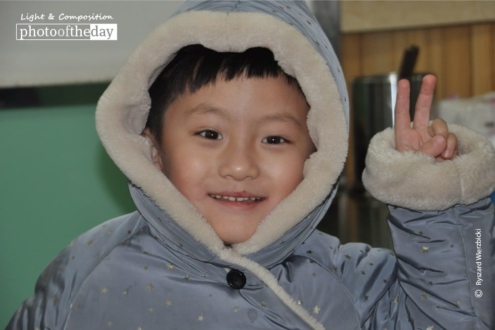
Ryszard Wierzbicki has captured this exact spirit in his image titled Victory Greeting. It serves as a gentle reminder that even in the middle of a crowded, unfamiliar city, a single gesture can dismantle the walls between us. Does it not make you want to reach out to the next stranger you pass?