
The Edges of Our Belonging
Public space is rarely neutral. We tend to view parks and waterfronts as democratic voids, empty stages waiting for us to perform our leisure. Yet, if we look closer at the geography of these sites, we see the invisible lines of access and exclusion. Who is permitted to linger? Who is pushed to the margins by the relentless pace of the city? The city is a document written in concrete and sand, recording who has the luxury of time and who is merely passing through. When we observe an intergenerational moment in a shared space, we are witnessing a claim on the city. It is a quiet reclamation of the urban environment, transforming a functional zone into a site of memory and connection. We must ask ourselves if our urban planning prioritizes these human rhythms, or if it treats the citizen as a mere unit of transit. Does the city exist to facilitate our movement, or to nurture the spaces where we actually belong?
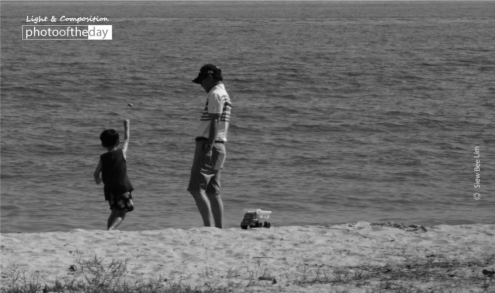
Siew Bee Lim has taken this beautiful image titled Throwing a Stone. It captures a fleeting moment of connection that reminds us how we inhabit the edges of our urban world. How do you see your own city—as a place to move through, or a place to stay?