The Edge of the Pavement
We often talk about the city as a collection of steel and glass, a vertical ambition reaching for the clouds. But the true document of human survival is found at the periphery, where the hard lines of infrastructure soften into the soil. Here, the road is not merely a path for transit; it is a boundary between the managed world and the sustenance of the earth. Who laid this asphalt, and for whose benefit was it poured? When we look at the fringes of a metropolis, we see the tension between the necessity of movement and the permanence of the harvest. These spaces are rarely neutral. They are the result of a thousand quiet negotiations between the state and the tiller, between the speed of the machine and the slow, rhythmic cycle of the seasons. To stand at this junction is to witness the fragile intersection of progress and tradition, where the city ends and the lifeblood of the land begins. Who is invited to traverse this path, and who is left to tend the green that borders it?
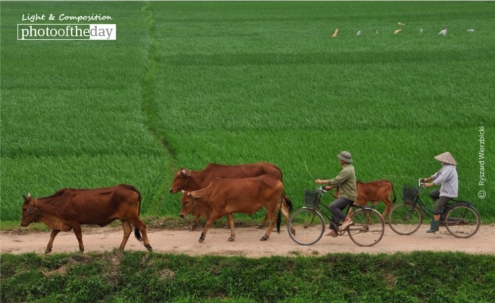
Ryszard Wierzbicki has captured this quiet negotiation in his work titled A Road by the Rice Field. It serves as a reminder that every stretch of pavement tells a story about the people who live in its shadow. Does this road lead to a place of belonging, or is it simply a way to pass through?