
The Architecture of Thresholds
We often mistake the threshold for a barrier, a line drawn to keep the outside world at bay. Yet, in the dense fabric of the city, the threshold is the most social space of all. It is where the private life of the home negotiates with the public life of the street. When we look at how a person positions themselves within a doorway, we are witnessing a claim to space—a silent declaration of belonging or a quiet retreat from the gaze of the passerby. These boundaries are never neutral; they are etched with the history of who is permitted to occupy the light and who is relegated to the shadows. The ironwork, the peeling paint, and the narrow frame are not merely decorative; they are the physical manifestations of social stratification. They tell us who is invited to participate in the urban ballet and who is expected to remain behind the grill. If the city is a document, what does it say about the people we choose to frame, and what does it hide about the people we choose to ignore?
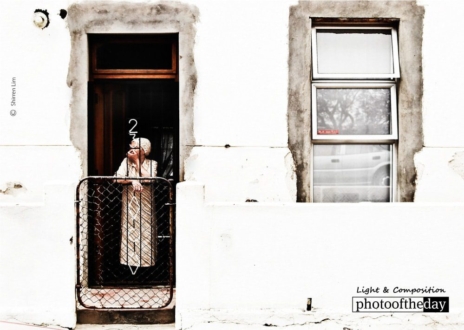
Shirren Lim has taken this beautiful image titled Days Go By. It captures that delicate tension between the individual and the structural environment of Cape Town. Does this threshold suggest a life of openness, or is it a boundary built to protect a private world from the city outside?