
The Architecture of the Path
Urban design often treats the ground as a mere utility—a surface to be paved, managed, and traversed as efficiently as possible. Yet, the way a path winds through a space reveals the true power dynamics of a city. When we look at a walkway, we are seeing a negotiation between the intention of the architect and the desire of the pedestrian. Some paths are designed to control movement, funneling bodies toward commercial centers or gated enclaves, while others emerge organically from the collective habit of those who walk them. These informal routes are the true veins of a community, representing the paths of least resistance carved out by people who refuse to be dictated by a grid. A path is never just a way to get from one point to another; it is a record of human agency, a testament to where we choose to place our weight and how we navigate the boundaries set before us. Who decides which way we are allowed to walk?
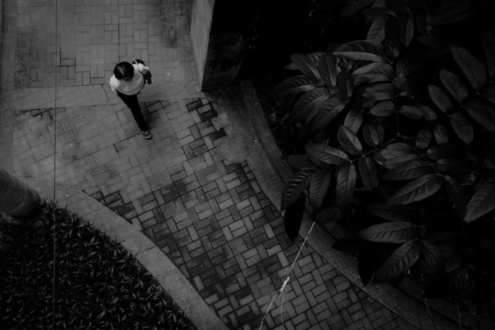
Rafael Lorenzo de Leon has captured this tension in his evocative image titled Brick Road. By looking down upon the path, he invites us to consider the relationship between the individual and the structured environment they inhabit. Does this road lead to a place that belongs to everyone, or is it a private corridor hidden from the public eye?