The Architecture of Silence
Cities are often defined by their noise—the relentless hum of traffic, the friction of commerce, the constant demand for our attention. We build our environments to be productive, to be efficient, to be loud. Yet, there is a profound social geography to silence. When the city is blanketed in white, the usual hierarchies of the street are temporarily suspended. The paths we carve through the concrete are erased, and the rigid lines of property and transit soften under a layer of quiet. In these moments, the city stops being a machine for movement and becomes a space for reflection. It reveals who is left outside when the warmth of the interior is no longer a guarantee, and who is permitted to linger in the public realm after the lights go down. We are reminded that the city is not just a collection of structures, but a living, breathing entity that changes its character the moment we stop rushing through it. What does the city reveal about us when it finally decides to be still?
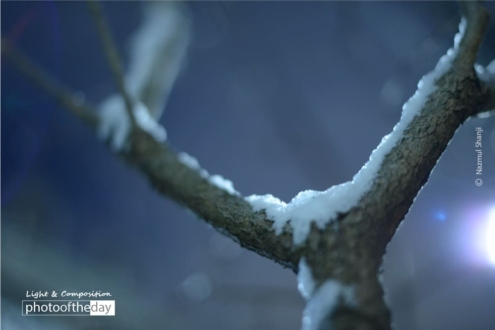
Madoka Hori has captured this quiet transformation in her image titled Midnight Snow. It serves as a stark reminder of how light defines our access to the urban landscape after dark. Does this stillness feel like a sanctuary to you, or does it highlight the isolation of the modern city?