
The Architecture of Shared Light
We often speak of the city as a collection of buildings, but it is more accurately a collection of intensities. In the dark, these intensities become visible as points of light—thousands of tiny, handheld beacons flickering in the void. When a crowd gathers in a cavernous space, they are not just consuming a spectacle; they are temporarily remapping the geography of the room. Each glowing screen acts as a surrogate eye, a way to witness and verify existence in a shared moment. It is a strange, modern ritual where the individual reaches out to capture a fragment of the collective experience, hoping to anchor themselves to a memory that is already slipping away. We are surrounded by these pockets of artificial illumination, yet we remain physically distant, each person a solitary node in a vast, pulsing network. Who are we when we are together, and what remains of the space once the lights go down and the crowd disperses into the night?
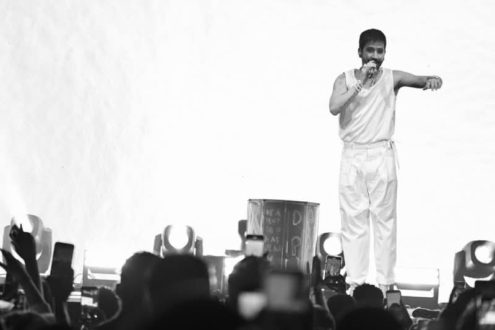
José J. Rivera-Negrón has captured this collective energy in his image titled Hands in the Air. It serves as a stark reminder of how we use technology to define our place within a crowd. Does this sea of light bring us closer together, or does it merely highlight the distance between us?