
The Architecture of Play
Public space is rarely neutral. When we design environments for children, we are essentially mapping out the boundaries of their future citizenship. We decide where they are permitted to run, where they must sit still, and which structures are meant to facilitate their development. In many parts of the world, the schoolyard acts as the primary laboratory for this social conditioning. It is a controlled geography where the rigid expectations of the adult world—represented by the uniform, the posture, and the schedule—collide with the raw, unscripted energy of childhood. We often mistake this collision for mere play, ignoring the underlying power dynamics at work. Who provided the equipment? Who maintains the ground? And what does it mean to be a child in a space that demands such visual uniformity even in moments of release? The city is built on these small, institutionalized stages, and we must ask ourselves if these spaces are designed to liberate the imagination or to merely contain it.
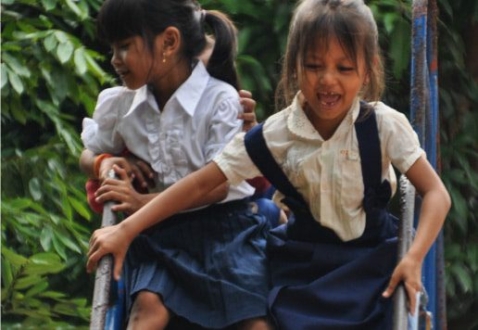
Ryszard Wierzbicki has taken this beautiful image titled Sliding Girls. It captures a moment of transition where the weight of institutional expectation meets the lightness of youth. How do you see the relationship between the structure of the environment and the freedom of those who inhabit it?