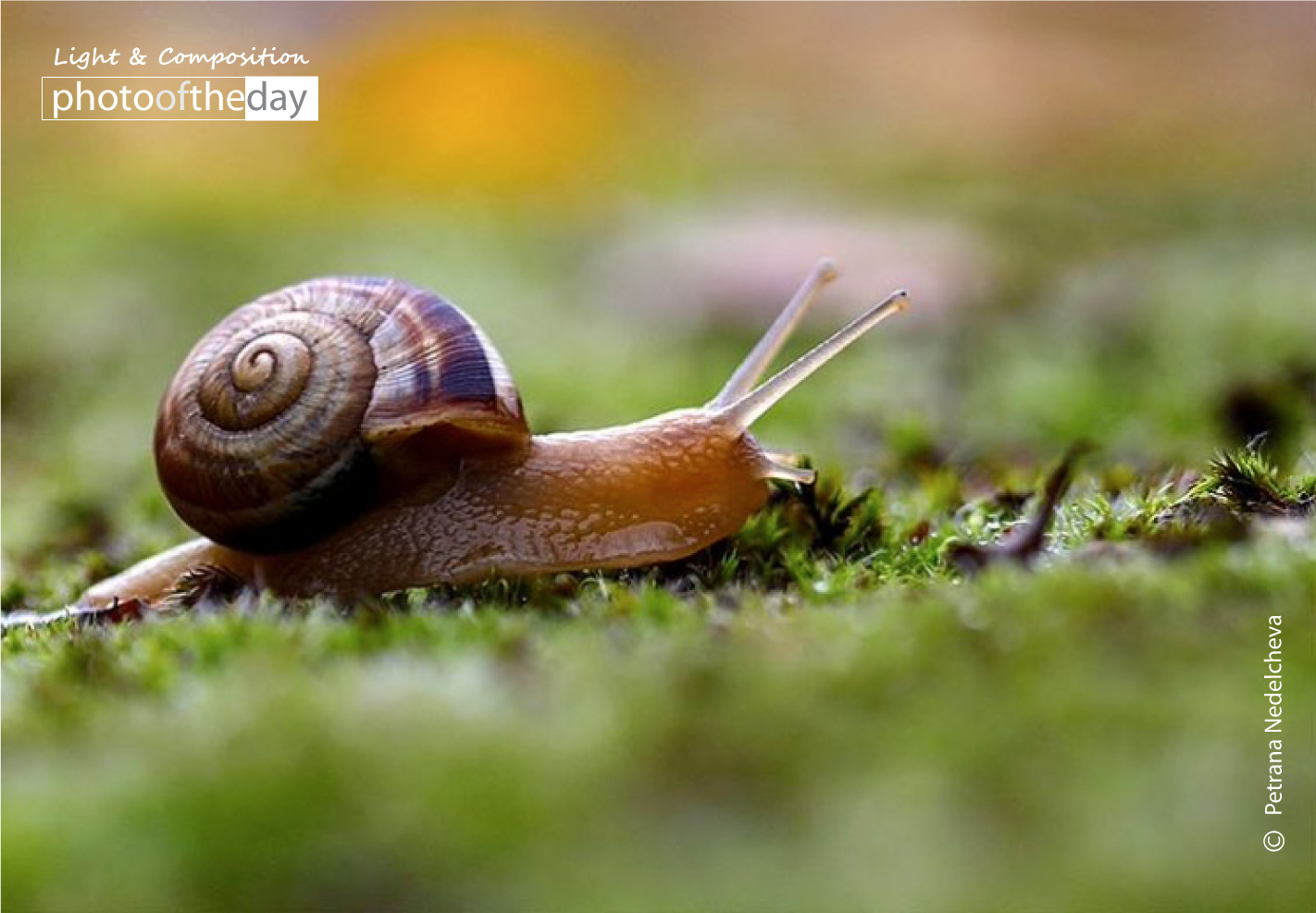
A Snail on My Way by Petrana Nedelcheva
Following a refreshing autumn rain, the photographer encountered a snail traversing a mossy, shadowed patch in the garden. Drawn to the quiet beauty of this often-overlooked creature, the photographer embraced the damp conditions, lying low on the wet ground to capture the subject from an intimate, eye-level perspective. This deliberate technical choice highlights the intricate textures of the snail and its environment, transforming a common garden visitor into a compelling macro study. The image succeeds by finding profound aesthetic value in the mundane, showcasing the photographer's patience and ability to elevate a simple, everyday moment into a striking piece of close-up photography.
Petrana Nedelcheva
Born in Sofia, Bulgaria, Petrana Nedelcheva currently resides in a rural village where she draws deep inspiration from the surrounding nature and her resident animals. Though she considers photography a personal hobby, her work reflects a refined focus on still life, particularly the artistry of sourdough bread and artisanal bakery products. By utilizing the simple, organic elements found within her home and the local landscape, Nedelcheva captures the authentic essence of village life and her profound connection to the natural world.
Resonance Score Breakdown
Transparency Note: The resonance score (8.6/20) is calculated based on social engagement metrics collected before the award announcement.
Expert Photography Reviews · 7
The Pace of Damp Earth
The smell of wet soil always brings me back to the garden after a storm. It is a heavy, metallic scent, like iron cooling in the dark.
Read the reflection →The Pace of Damp Earth
There is a specific weight to the air after a long, soaking rain, a heaviness that settles into the soil and turns the garden into a place of slow, deliberate movement. In the north, we know this dampness as a kind of silence; it is the smell of wet stone and dark, cooling moss.
Read the reflection →Reviews & Comments
Share your thoughts about this award-winning photograph. Your reviews contribute to the community engagement score.
Before the eye identifies the shell, something in the chest slows. The damp, mossy green triggers a primal, cooling sensation—a stillness I haven’t felt since childhood. It’s not just a snail; it’s the weight of time moving at a pace we’ve forgotten how to inhabit. When I return to this, I feel the grit of the wet earth against my own skin. It’s a quiet, persistent ache that lingers long after I look away.
Most people walk past the dirt. They don’t see the world at ground level. Petrana got down in the mud, and honestly, it makes me want to grab my camera and hit the pavement right now. It’s a quiet, slow-motion decisive moment. One tenth of a second later and the snail retreats, the frame collapses. She caught the texture of the moss perfectly. It’s not just a bug; it’s a tiny, unrepeatable city street.
The damp, mossy velvet of this garden floor acts as a lush, verdant stage, its textures drinking in the autumn light. It’s a world of miniature topography, where every dewdrop reflects a hidden, quiet universe. I’m genuinely moved by how the snail’s spiral shell mirrors the complexity of the terrain it navigates. By lowering herself to the mud, Petrana doesn’t just document a creature; she grants us an intimate, humbling perspective on a life lived in the shadows.
The macro perspective here echoes the tactile intimacy of Karl Blossfeldt’s plant portraits, yet Nedelcheva’s snail avoids his clinical detachment. By embracing the damp, low-angle light, she finds a wet, glistening texture that recalls the atmospheric depth of early Pictorialist studies. It’s a quiet, humble observation, but honestly, I’m genuinely charmed by the way she renders the moss’s topography. It’s not just a garden study; it’s a deliberate, patient dialogue with the microscopic world.
The snail doesn’t merely crawl; it navigates the abyss of the moss. By sinking into the damp earth, Nedelcheva forces us to confront the weight of existence in the dark. It’s a heavy, suffocating beauty that resists the light. I’ve felt that same crushing silence in a Tarkovsky frame, where time itself seems to thicken. It’s unsettling, really. The shadow here isn’t a void, but a deliberate, thinking space where the creature finally finds its gravity.
The focal plane here is razor-thin, barely containing the snail’s mantle. By pushing the aperture to its limit, Petrana’s captured the diffraction of light across the damp, mucilaginous surface with startling clarity. It’s a masterclass in managing the diffraction limit; the moss textures don’t just blur, they dissolve into a creamy bokeh as a function of that wide aperture. I’ve stared at this for an hour—the way the light refracts through the slime is simply breathtaking.
It’s a curious exercise to view this macro study as a built environment. The moss acts as a textured datum, a landscape of soft, organic topography. The snail’s shell, with its spiraling geometry, mimics the structural logic of a vaulted rotunda. I’m struck by how the light catches the damp, glistening surfaces; it’s almost like watching a structure emerge from the rain. It’s intimate, yet it captures the sheer scale of a world we usually overlook.