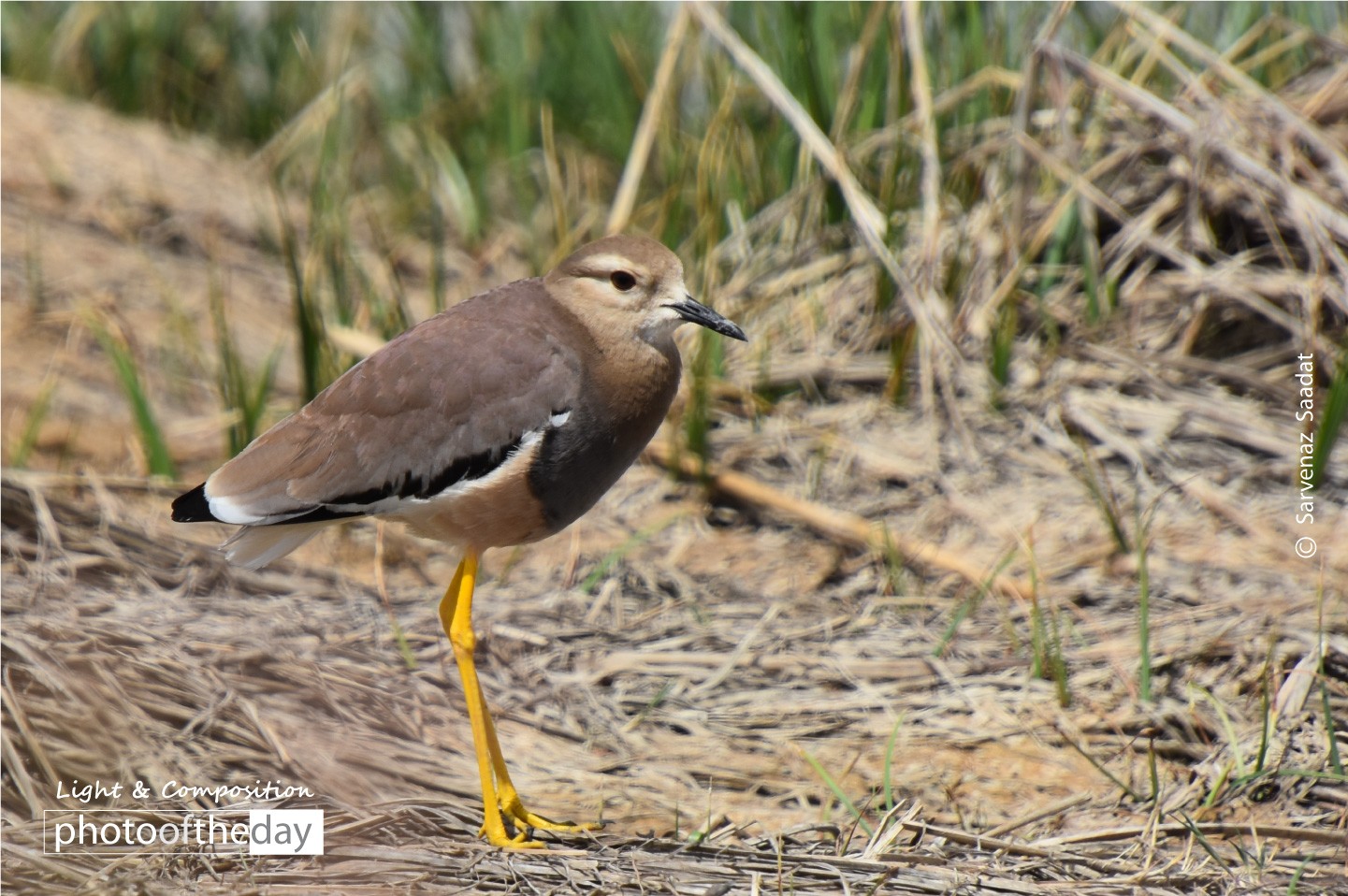
Yellow Boots by Sarvenaz Saadat
Captured at the Salehiyeh Wetland in Iran, this image documents a dramatic shift in weather that forced a group of white-tailed plovers to seek shelter. Initially resting in the morning sun, the birds were driven to the cover of tamarix trees as a sudden storm brought lightning and heavy rain. The photographer’s ability to anticipate this behavioral change and capture the birds in their refuge highlights a keen observational skill. The juxtaposition of the delicate wildlife against the impending storm, rendered with sharp detail, makes this a compelling and award-worthy wildlife portrait.
Sarvenaz Saadat
Born in 1988 and based in Karaj, Iran, Sarvenaz Saadat is an architect and dedicated amateur photographer with a profound passion for nature, landscape, and wildlife. Her photographic journey began in high school with a Nikon Coolpix 3200, evolving into a sophisticated practice that blends her interest in birdwatching with wilderness exploration. Currently pursuing formal studies in art and photography, she strives to transition into a professional career, capturing the raw beauty of the natural world through her lens.
Resonance Score Breakdown
Transparency Note: The resonance score (9.0/20) is calculated based on social engagement metrics collected before the award announcement.
Expert Photography Reviews · 5
The Architecture of Shelter
There is a quiet, ancient intelligence in knowing when to retreat. We are taught to admire the bold, the ones who stand firm against the gale, yet there is a profound dignity in the act of finding cover.
Read the reflection →The Shelter of Small Things
Why do we assume that strength is found in standing against the gale, rather than in the quiet wisdom of seeking cover?
Read the reflection →Reviews & Comments
Share your thoughts about this award-winning photograph. Your reviews contribute to the community engagement score.
Would like to follow her visions
The tamarix branches create a chaotic, skeletal architecture, framing the plovers like a sanctuary carved from the storm. It’s the tension between those fragile, yellow-legged silhouettes and the encroaching grey gloom that truly moves me. I’ve always loved how nature dictates its own portraiture. Here, the wetland isn’t just a backdrop; it’s a protective, unforgiving host. The birds don’t just exist in this space—they are defined by the very shelter that keeps them alive.
Before the eye identifies the plovers, a sudden stillness settles in the chest. It’s the weight of the coming storm, that heavy, electric air pressing against the skin. I’ve felt this exact tension before a downpour, the way the world holds its breath. When I return to these yellow boots, I don’t see birds; I feel the frantic, fragile need for shelter. It’s a quiet, aching reminder of how quickly our own safety can vanish.
The frame operates on a strict 3:1 ratio of chaotic, dark foliage against the birds’ stark white plumage. Those plovers anchor the lower-right quadrant, creating a perfect visual fulcrum that balances the heavy, atmospheric tension above. I’m genuinely struck by how the tamarix branches act as geometric vectors, forcing the eye toward the center. It’s a beautifully solved spatial equation; the birds’ stillness amidst that frantic, angular tangle of twigs is just brilliant mathematics.
It’s technically competent, sure, but that’s precisely why it leaves me cold. By freezing the plovers at 1/500sec, Saadat has opted for the most conservative path. I’d have loved to see the storm’s kinetic energy smeared across the frame, perhaps echoing the blurred, painterly traditions of Hiroshi Sugimoto. Why resolve every feather when the weather itself is the real subject? It’s a missed opportunity to trade clinical sharpness for the visceral, chaotic truth of a wetland storm.
Nature doesn’t wait for your settings. You’re out in the Salehiyeh wetlands, the sky turns black, and the birds scramble. That’s the street, just with feathers instead of pedestrians. I love the tension here. You caught them right as the storm broke, not a second after. If you’d hesitated, the birds would’ve vanished into the tamarix. It’s raw, it’s urgent, and it’s perfectly timed. You were paying attention. That’s how you win.