Sunset Near Three Sisters by Manon Mathieu
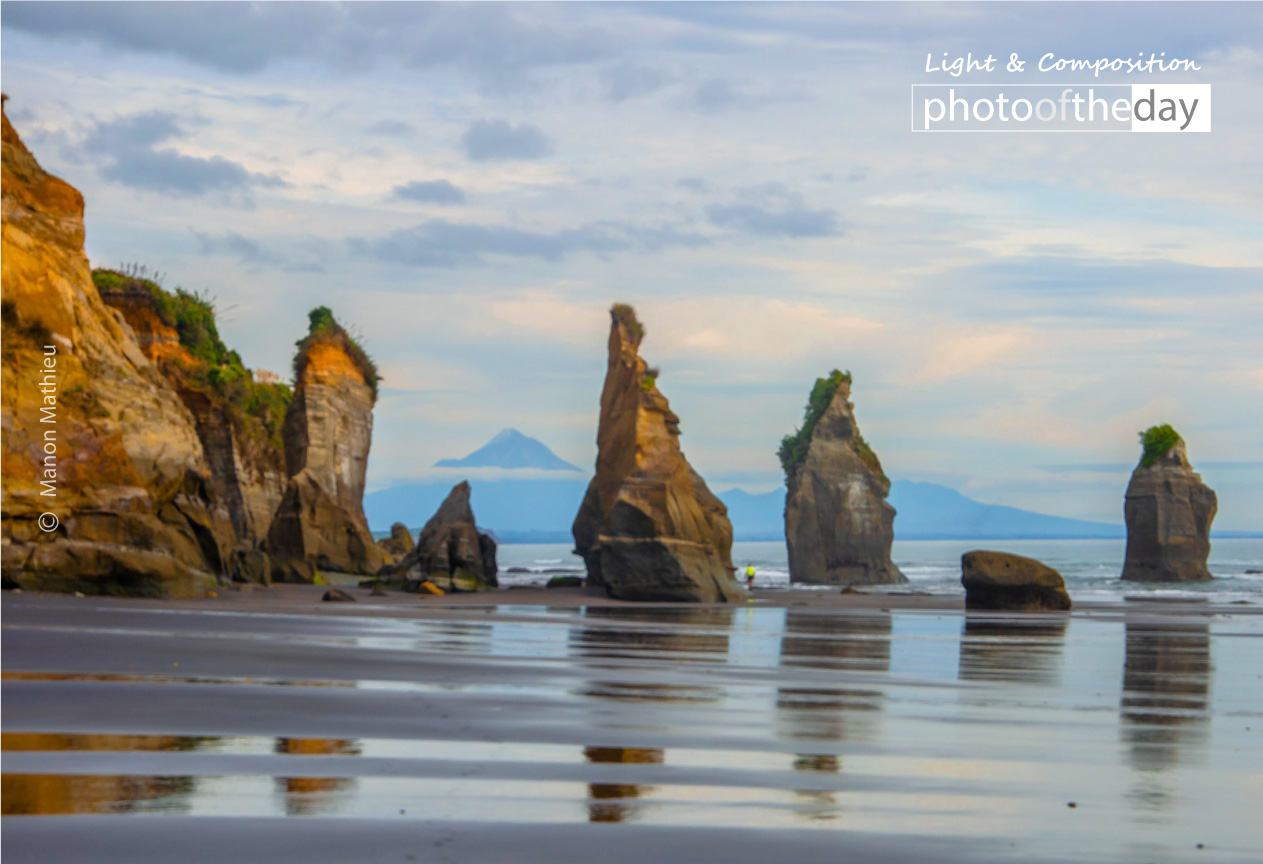
Captured during the golden hour at low tide, this photograph showcases the dramatic coastline of the Taranaki region. As the Tasman Sea recedes, the iconic rock formations known as the Three Sisters emerge, bathed in the soft, ethereal light of the setting sun. In the distance, the majestic silhouette of Mount Taranaki provides a perfect, imposing backdrop to the serene beach scene. The photographer’s decision to wait for the low tide allowed for a unique perspective on these geological giants, resulting in an award-worthy composition that balances the raw, rugged texture of the cliffs with the tranquil, fleeting beauty of the New Zealand sunset.
Manon Mathieu
Born in the south of France, Manon Mathieu is a journalist who has resided in diverse locales ranging from Paris to Provence. Currently, she documents her global travels from the comfort of a campervan, focusing her lens on the natural landscapes and hidden walkways of New Zealand. Her photography is deeply rooted in a desire to capture the moving, evocative moments of the natural world, reflecting a life dedicated to exploration and the quiet observation of her surroundings.
Resonance Score Breakdown
Transparency Note: The resonance score (10.1/20) is calculated based on social engagement metrics collected before the award announcement.
Expert Photography Reviews · 5
Where the Tide Retreats
The shore is a place of constant negotiation. The sea claims, then it yields. We walk the line between what is solid and what is fluid, forgetting that the ground beneath us is only a temporary agreement.
Read the reflection →The Weight of Stone
I keep a small, smooth river stone in the pocket of my winter coat, a weight I often find myself rubbing between my thumb and forefinger when the world feels too thin.
Read the reflection →Reviews & Comments
Share your thoughts about this award-winning photograph. Your reviews contribute to the community engagement score.
Taranaki’s silhouette echoes the precise, volcanic isolation of Hiroshi Sugimoto’s seascapes, yet Mathieu’s foreground lacks that meditative stillness. The Three Sisters, caught in this golden hour, struggle to escape the postcard trap. I’ve seen this geological drama a thousand times since the Pictorialists first romanticized such rugged coastlines. It’s technically sound, but I’m still waiting for a perspective that disrupts the horizon. Honestly, I’m exhausted by the sunset; I’d love to see these rocks in a storm.
f/11 at 1/15s, ISO 100, 24mm. A standard landscape configuration, yet it’s executed with clinical precision. The diffraction limit hasn’t compromised the sharpness of the Three Sisters’ basalt textures. I’ve seen a thousand sunset shots, but the exposure balance here is actually impressive; it doesn’t crush the shadows into oblivion. You’ve managed to keep the highlights from clipping while maintaining structural integrity. It’s a technically sound argument for the scene. I’m genuinely impressed by the restraint.
Most landscape entries I’ve reviewed this year settle for postcard perfection. Manon’s work avoids that trap because of the tension between the wet, reflective sand and the looming, jagged silhouettes. It’s the way the light clings to the Three Sisters that makes me stop and breathe. I’ll admit, I felt a genuine ache for that shoreline. It’s not just a sunset; it’s a record of a fleeting, geological patience that will still matter in thirty years.
You waited for the tide to pull back, and that patience pays off. It’s a quiet, heavy scene. I’ve stood on beaches like this, feeling small against the weight of the earth, and you’ve captured that exact ache. The way the light hits those rocks feels like a secret you were lucky to catch. And because you didn’t rush it, the mountain feels like a silent witness. There’s something honest happening here. You felt the stillness.
These geological forms act as natural fenestration, framing the horizon with a brutal, tectonic weight. I’m struck by how the receding tide reveals a datum line across the sand, grounding these monoliths in a fleeting, temporal state. It’s a rare moment where the solid-void relationship feels truly precarious. I’ve walked similar coastlines, and seeing the light catch those jagged edges makes me ache for the salt air. It’s an honest study of erosion’s architecture.