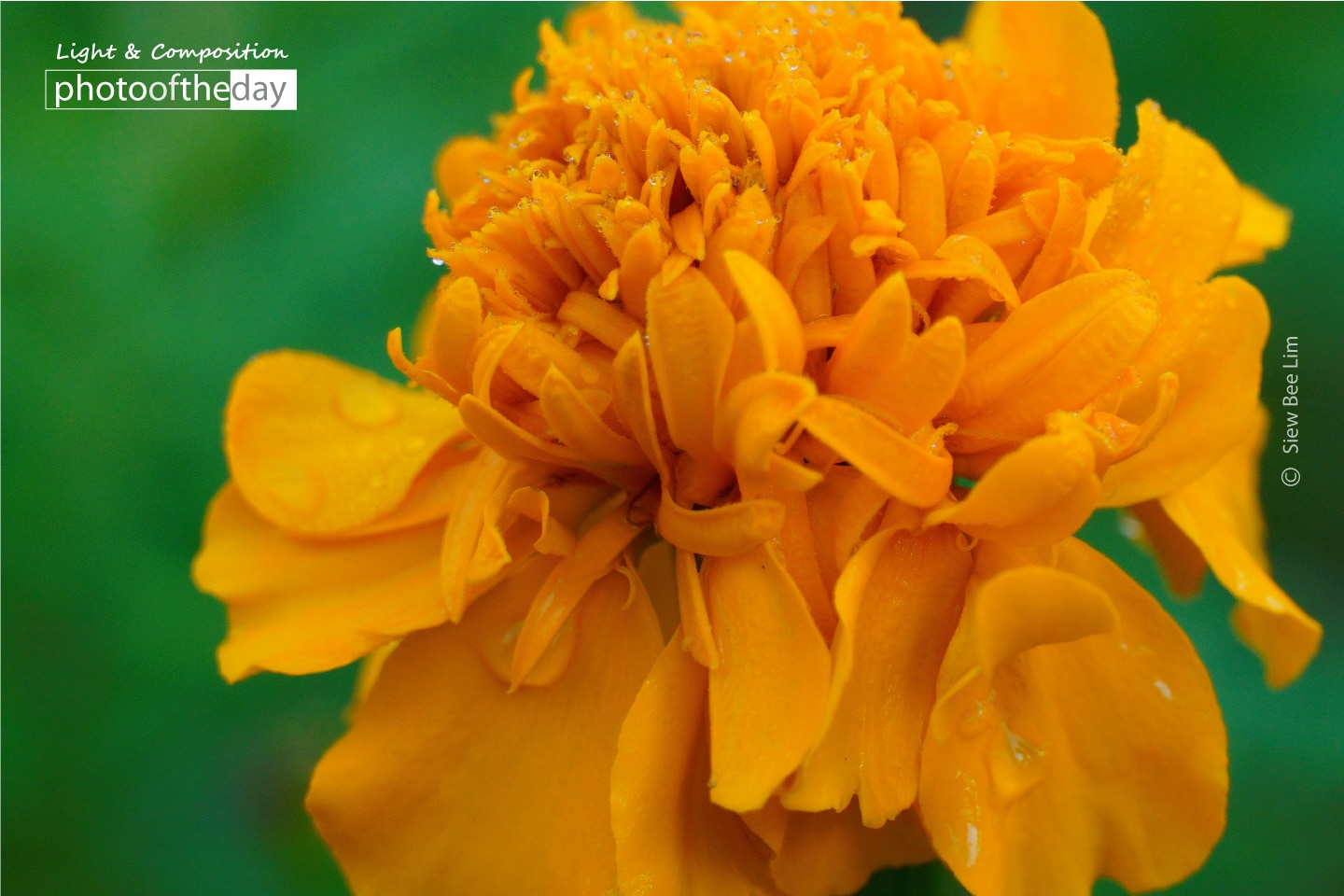
Marigold by Siew Bee Lim
Captured during a quiet morning in a local park, this close-up study of a marigold highlights the delicate interplay of light and texture. The photographer focused on the intricate details of the petals, accentuated by the soft, glistening dew that gathered in the early hours. By isolating the subject, the image reveals the hidden depth and dimension of a common flower, transforming a simple botanical specimen into a compelling visual narrative. The work stands as an award-worthy exploration of nature’s textures, demonstrating a keen eye for the beauty found in everyday surroundings.
Siew Bee Lim
Born in 1965 in Singapore, Siew Bee Lim is a dedicated photographer who rediscovered her passion for the craft later in life. Though she spent her professional career as a programmer, she has long nurtured an appreciation for visual arts and Chinese painting. Currently refining her technical expertise through formal study, she seeks to bridge the gap between her early darkroom experiences and the modern digital landscape, viewing photography as a lifelong journey of creative growth.
Resonance Score Breakdown
Transparency Note: The resonance score (11.6/20) is calculated based on social engagement metrics collected before the award announcement.
Expert Photography Reviews · 6
The Weight of Small Things
I spent twenty minutes this morning trying to find my keys, only to realize they were sitting right under a pile of mail I had ignored all week. It was frustrating, but it forced me to slow down and actually look at the surface of my desk.
Read the reflection →The Architecture of the Unseen
We often mistake the city for a collection of concrete, steel, and glass—a rigid grid designed to move bodies from one point of production to another.
Read the reflection →Reviews & Comments
Share your thoughts about this award-winning photograph. Your reviews contribute to the community engagement score.
Dew on a marigold isn’t a street scene, but it’s a study in patience. I’ve spent years chasing the chaos of Moriyama’s Tokyo, yet this quiet focus hits me. It’s about the light hitting that moisture at exactly the right micro-second. One tenth of a second later and the sun shifts, the glisten dies, and the magic vanishes. It’s not the street, but it’s the same discipline. You caught the breath of the morning. Well done.
The light hits the dew and the frame snaps into focus. It’s a tight, rhythmic close-up that feels like a lingering insert shot in a slow-burn drama. I’ve seen a thousand flowers, but this one holds. The texture of those petals creates a tension that doesn’t need a cut. It’s quiet, precise, and honestly, it makes me want to slow my own breathing down. The editor keeps this frame because it’s already a complete story.
Most close-ups of marigolds are just botanical records, but this one lingers. The way the dew clings to the serrated edges of the petals forces you to slow down. I’ve seen thousands of floral studies, yet this one’s restraint keeps it from feeling clinical. It’s the quiet geometry of those water droplets that makes me want to reach out and touch the screen. In thirty years, this simplicity will still feel honest, unlike the over-processed clutter I usually reject.
It’s a shame Lim stopped at mere documentation. We’re presented with a crisp, polite marigold, yet I’m left craving a subversion of that 135mm compression. Why resolve every petal so clinically? I’d have preferred a deliberate motion blur to dissolve the dew into light, echoing the ethereal abstraction of Sugimoto’s seascapes. When you choose perfect sharpness, you’re just recording biology. I’m bored by the clarity; I want to see what happens when the flower finally lets go.
Botanical studies have been exhausted since Blossfeldt’s rigid typologies, yet Lim finds a quiet, glistening vitality here. The dew’s refraction against the marigold’s serrated edges echoes the tactile precision of Imogen Cunningham’s early floral work, though it’s less clinical. I’m genuinely moved by how the f/5.6 aperture softens the background, pulling the viewer into the petal’s geometry. It’s a familiar subject, sure, but the light’s clarity feels fresh. It’s a lovely, disciplined conversation with the past.
At f/5.6, the 135mm focal length creates a shallow depth of field that isolates the marigold’s cellular structure with surgical precision. The diffraction of light across those dew-laden petals is, in the strictest physical sense, extraordinary. I’m genuinely moved by how the lens resolves the micro-textures that our eyes usually ignore. It’s a rare moment where the glass doesn’t just capture a flower; it reveals the complex, glistening geometry of life itself. It’s simply beautiful.