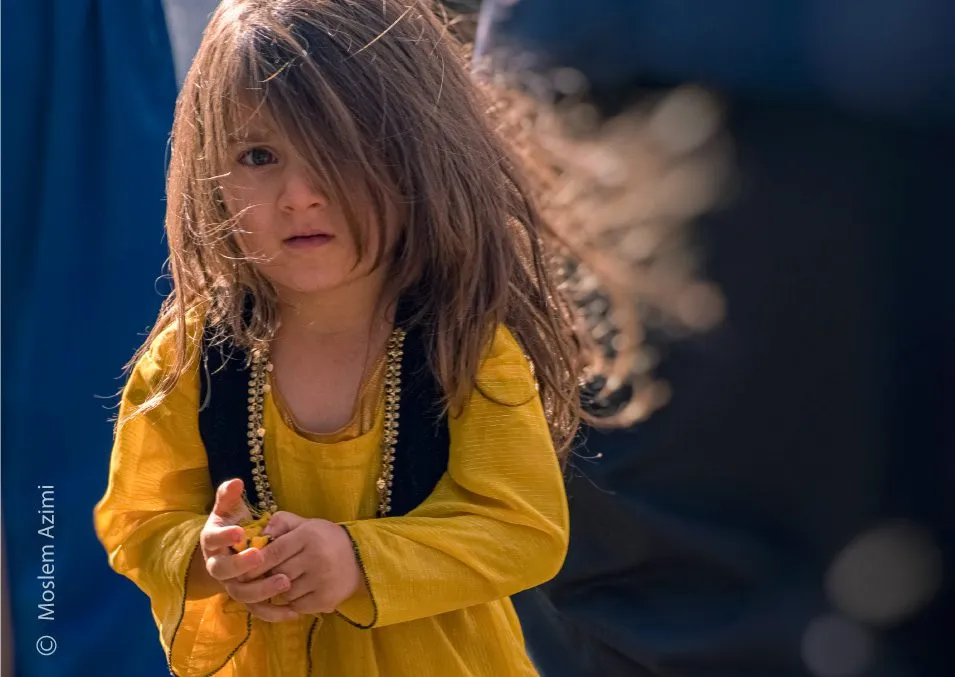
Innocent Eyes by Moslem Azimi
In the ancient Kurdish city of Hawraman, Iran, Moslem Azimi captured a poignant moment featuring a young girl adorned in a vibrant yellow traditional dress. The photographer navigated the crowded streets with a sensitive approach, prioritizing the subject's comfort over a perfectly posed composition. By choosing to respect the girl's visible embarrassment rather than intruding, Azimi preserved the authenticity of the encounter. The resulting image is a delicate portrait that highlights the intersection of traditional Kurdish attire and the raw, unscripted emotions of childhood, earning recognition for its empathetic storytelling and cultural significance.
Moslem Azimi
Moslem Azimi is a self-taught photographer of Kurdish origin currently based in Melbourne, Australia. Holding a Bachelor of Arts in English Translation, he transitioned his creative focus toward documenting the rich traditions, lifestyle, and cultural heritage of the Kurdish people. His work has been featured in numerous national and international exhibitions, reflecting his dedication to visual storytelling. Azimi continues to refine his craft through active participation in photography communities, striving to bridge the gap between his heritage and a global audience through his evocative portraiture.
Resonance Score Breakdown
Transparency Note: The resonance score (10.5/20) is calculated based on social engagement metrics collected before the award announcement.
Expert Photography Reviews · 5
The Geography of Belonging
We often speak of the city as a collection of infrastructure—roads, grids, and zoning laws—but the true city is written in the faces of those who navigate its thresholds. Every public space is a negotiation of power. Who is permitted to stand still?
Read the reflection →The Weight of a Glance
I was standing in the grocery store aisle this morning, trying to decide between two brands of tea, when a little girl in the next row caught me staring. She was hiding behind her mother’s coat, peeking out with eyes that seemed to hold a thousand questions.
Read the reflection →Reviews & Comments
Share your thoughts about this award-winning photograph. Your reviews contribute to the community engagement score.
Yellow silk against stone. The girl’s gaze drifts, avoiding the lens. It’s a quiet resistance. I’ve spent minutes watching her look away. She isn’t performing for us. Azimi lets the street blur into a soft, grey hum. Nothing here is accidental. The empty corner is not empty. It’s the weight of her hesitation. I feel a sudden, sharp ache in my chest. She’s allowed to be elsewhere. Silence is the most honest portrait.
The yellow fabric creates a jarring chromatic weight that destabilizes the frame. It’s a chaotic splash of color lacking the structural anchor required to hold the eye. The subject’s gaze drifts, failing to establish a clear fulcrum within the picture plane. I’m honestly exhausted by this reliance on cultural sentiment to mask a lack of formal discipline. The composition doesn’t resolve; it merely exists. It’s a missed opportunity for geometry to provide the necessary rigor.
Hawraman’s terraced vernacular creates a rugged datum, yet here, the architecture recedes into a soft, out-of-focus blur. The yellow dress acts as a vibrant threshold, pulling the eye away from the stone massing. I’m struck by how the girl’s hesitation mirrors the way light catches the rough masonry behind her. It’s a fleeting, spatial tension. You don’t just see the girl; you feel the weight of the ancient, vertical city pressing against her fragile, human presence.
The girl’s hesitation recalls the unvarnished vulnerability in Helen Levitt’s street portraits, yet the vibrant yellow fabric anchors this firmly in Hawraman’s specific cultural geography. It’s a delicate dance between the subject’s shyness and the lens. I’ve spent decades cataloging such fleeting encounters, but the raw, unposed quality here genuinely caught me off guard. It doesn’t rely on artifice; it’s a quiet, honest dialogue that avoids the trap of exoticism while honoring a long, complex lineage.
At f/5.6, the focal plane is razor-thin, yet it resolves the girl’s iris with startling clarity. I’m genuinely moved by how the lens captures the micro-contrast in her skin, revealing textures the naked eye simply misses. The diffraction across the yellow fabric is precise, avoiding the softness that often plagues portraits. It’s a rare moment where the optics don’t just record light; they hold the vulnerability of a child’s gaze with absolute, unforgiving scientific honesty.