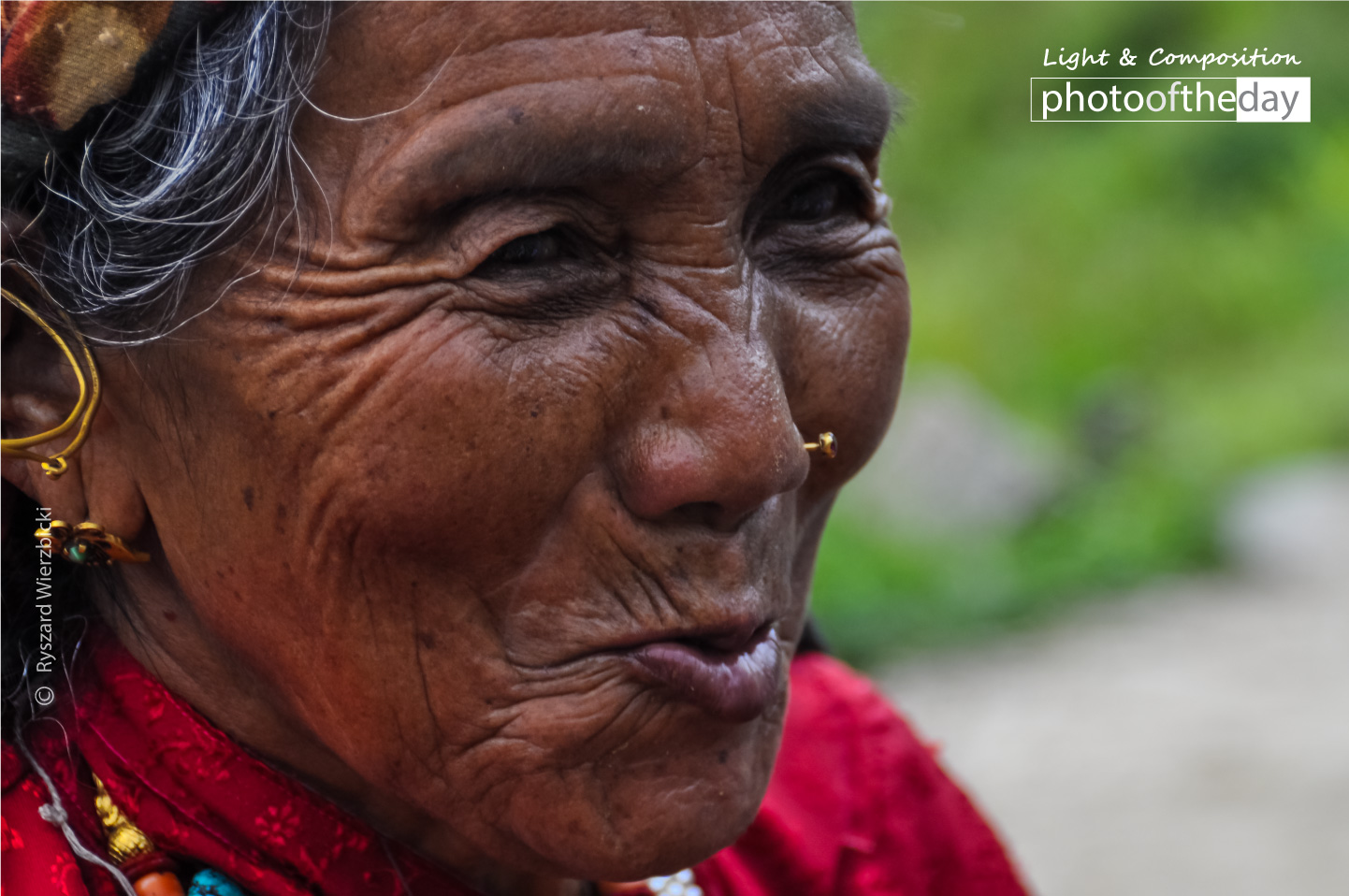
A Himalayan Woman by Ryszard Wierzbicki
Captured during a trek along the Annapurna Circuit in Nepal, this portrait highlights the resilient spirit of a local Himalayan woman. The photographer was struck by the warmth and friendliness of the villagers, who maintain their welcoming nature despite the harsh, high-altitude climate. By focusing on the subject’s genuine expression, the image serves as a poignant reminder of the human connection found in remote landscapes and the importance of supporting local communities. The photograph is award-worthy for its ability to bridge the gap between traveler and local, capturing a moment of profound cultural grace and quiet dignity.
Ryszard Wierzbicki
Born in 1963 and a graduate of the University of Gdańsk, Ryszard Wierzbicki transitioned from a diverse career in social sciences and marketing to become a dedicated traveler and photographer after moving to the UK in 2006. He is deeply committed to humanitarian efforts, frequently volunteering with organizations like Stu and the Kids to support orphans in Southeast Asia. Now based in Swindon, he balances his professional life as a marketing advisor with his passion for exploring the world, documenting his journeys through his photography and his established travel forums.
Resonance Score Breakdown
Transparency Note: The resonance score (11.7/20) is calculated based on social engagement metrics collected before the award announcement.
Expert Photography Reviews · 8
The Weight of Quiet Dignity
Seneca once observed that we are often more frightened than hurt, and that we suffer more in imagination than in reality.
Read the reflection →The Geography of Resilience
We often mistake the periphery for the margins, assuming that distance from the urban core equates to a lack of complexity. Yet, in the high-altitude reaches of the world, geography dictates a social contract far more rigorous than any city ordinance.
Read the reflection →Reviews & Comments
Share your thoughts about this award-winning photograph. Your reviews contribute to the community engagement score.
Wierzbicki’s portrait leans into a conventional sharpness that I find frankly exhausting. It’s technically competent, sure, but it lacks the courage to obscure. Why resolve every wrinkle when the mountain air itself is a blur of shifting light? I’m craving a dissolution of form here—something closer to Sugimoto’s long-exposure ghosts. It’s a missed opportunity to let the subject bleed into the landscape. I’d trade this clinical clarity for just one honest, beautiful mistake.
You didn’t just take a portrait; you sat with her. I can see the altitude in the lines around her eyes, but it’s that genuine, unforced smile that hits me. It’s rare to find a traveler who doesn’t turn a local into a prop. You waited, and you listened. Because you were present, she let you in. There’s something honest happening here. It’s a quiet, human grace that I haven’t felt in a long time.
The vertical axis aligns perfectly with the subject’s gaze, creating a stable, centered equilibrium. I’m struck by the 3:2 ratio of the weathered facial textures against the blurred, negative space of the background. The geometry here is remarkably tight; the slight tilt of her head introduces a subtle diagonal vector that prevents the composition from feeling static. It’s a beautifully solved spatial equation. I’ve rarely seen such a complex, rugged landscape reduced to such elegant, balanced form.
The ochre of her weathered skin, reminiscent of a Morandi still life, vibrates against the bruised, slate-grey shadows of the high-altitude peaks, creating a chromatic tension that’s truly breathtaking. It’s the way the light catches the deep, bruised violet of her woollen shawl that makes my heart ache; one feels the biting cold of the Annapurna air, yet the warmth of her gaze remains, a golden, flickering ember against the vast, indifferent mountain silence.
There’s a profound stillness in her eyes that tells me she wasn’t just a target for a lens. She’s looking right back at Ryszard, meeting him halfway. You can see the trust in the way her hands rest, unhurried and soft. It’s a gift, not a theft. Honestly, looking at those deep, weathered lines, I feel a sudden, quiet ache for the life she’s lived. This face has a whole world in it.
The shutter clicks, and the mountain wind stops dead. It’s a tight close-up, a frame the editor keeps because it refuses to blink. Her eyes hold a rhythm I’ve spent years chasing on set. The depth of field is surgical; it isolates her grace against the blur of the Annapurna trail. I’m genuinely moved by how she anchors the frame. A cut would have been a mistake. This is the shot that defines the entire sequence.
The thin, high-altitude air seems to hold its breath here. She isn’t just a subject; she’s an extension of the mountain’s own stillness. I’ve spent enough dawns waiting for the light to soften to recognize that look—the patience of someone who knows the wind better than her own name. It’s humbling. When I look at her weathered skin, I don’t see a portrait. I see the landscape itself, finally deciding to look back at us.
Of the thousands of portraits I’ve reviewed, most rely on exoticism to do the heavy lifting. Wierzbicki avoids that trap. The way the light catches the deep, weathered lines around her eyes isn’t just technical skill; it’s an invitation. I’ve looked at this for ten minutes, and I still feel a lump in my throat. It’s the lack of artifice that ensures this will endure. It’s a rare, honest bridge across a vast cultural divide.