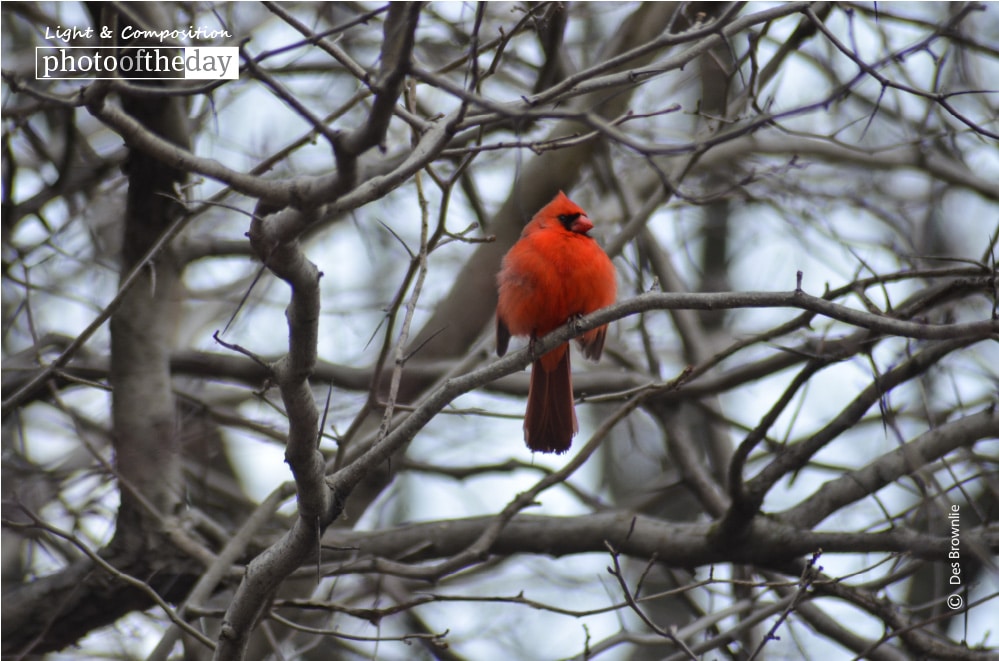
Red Robin in Central Park by Des Brownlie
On a bleak, overcast January day in Central Park, the landscape was stripped of color, with bare trees and the threat of snow looming overhead. Amidst this monochromatic winter scene, the photographer spotted a vibrant red robin, which served as a striking beacon of life against the dreary backdrop. By tracking the bird until it settled on a branch, the photographer captured a moment of vivid contrast. This image is award-worthy for its ability to transform a mundane, grey winter afternoon into a compelling narrative of color and resilience, highlighting the beauty that can be found in the most unexpected urban encounters.
Des Brownlie
Originally from Glasgow, Scotland, Des Brownlie relocated to New York City eighteen years ago and now resides in Manhattan. He is a dedicated street and urban photographer who finds inspiration in the constant variety of the city, always keeping his camera ready to document both the ordinary and the extraordinary. His work reflects a deep appreciation for the vibrant, ever-changing tapestry of New York life, which he captures through a lens of curiosity and constant observation.
Resonance Score Breakdown
Transparency Note: The resonance score (12.1/20) is calculated based on social engagement metrics collected before the award announcement.
Expert Photography Reviews · 5
The Persistence of Color
In the deep midwinter, the world often retreats into a study of charcoal and bone. We are told that nature sleeps, that the sap slows, and that the vibrant spectrum of the warmer months is merely a memory we must hold onto until the thaw.
Read the reflection →The Ember in the Grey
Winter is a patient architect, stripping the world down to its skeleton until only the essential lines remain.
Read the reflection →Reviews & Comments
Share your thoughts about this award-winning photograph. Your reviews contribute to the community engagement score.
The frame operates on a rigid 3:1 ratio of negative space, where the desaturated, chaotic lattice of branches creates a dense, grey field. The robin acts as a singular, high-intensity vector, positioned precisely at the intersection of the upper-right rule-of-thirds grid. It’s a perfect geometric anchor. I’m genuinely thrilled by how that tiny splash of crimson resolves the entire composition’s tension. Without that specific coordinate, the image would simply collapse into a messy, unweighted visual equation.
Before the eye identifies the robin, something in the chest tightens. It’s that sudden, sharp activation of color against the grey, a visual pulse that forces a shallow breath. I’ve looked at this a dozen times, and that red still feels like a small, frantic heartbeat against the winter’s indifference. When I return to it, I don’t see a bird; I see the precise, quiet ache of surviving a cold, lonely afternoon in the city.
The focal plane sits perfectly on the robin’s eye, resolving the iris’s intricate structure against the soft, out-of-focus winter twigs. At this aperture, the bokeh is a function of the lens’s exquisite glass, rendering the grey background into a creamy, neutral canvas. It’s a rare moment where diffraction doesn’t soften the plumage’s texture. Honestly, seeing that tiny, vibrant spark of life captured with such clinical sharpness against the bleak New York cold just takes my breath away.
A splash of red against a grey, urban void feels almost too convenient. Does this robin exist for its own sake, or is it merely a prop for our romanticized vision of Central Park? I find the forced contrast exhausting. Why do we insist on framing nature as a decorative relief from the city’s bleakness? It’s a pretty shot, sure, but it ignores the bird’s reality. Whose hunger are we actually feeding with this aesthetic?
A robin in January is a stubborn creature, and one suspects Mr. Brownlie is equally so. It’s easy to snap a bird in the sun, but tracking this splash of red through a grey, biting New York afternoon requires a particular sort of misery. I’ve spent enough hours shivering in the brush to know the ache in his fingers. He didn’t just find this; he earned it. It’s a decent bit of work.