Who Is He? by Ryszard Wierzbicki
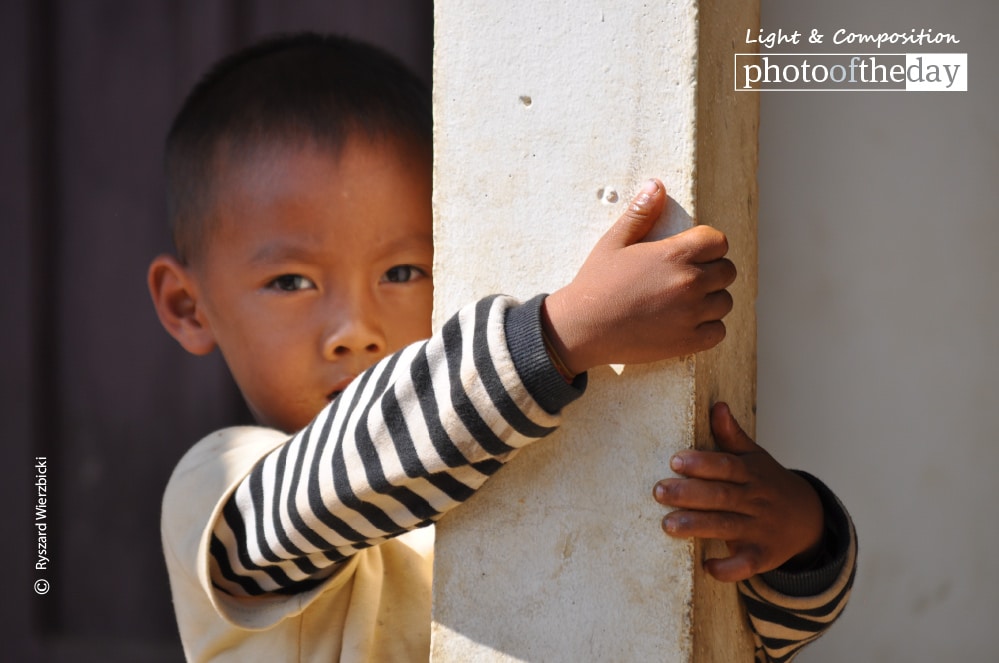
Captured during a journey between Phonsavan and Luang Prabang in December 2012, this portrait documents a serendipitous encounter in a local Laotian village. Initially hesitant at the sight of a foreign visitor with a camera, the young boy’s curiosity eventually overcame his apprehension, leading to this poignant interaction. The photographer masterfully utilized a 125mm focal length to isolate the subject, capturing a moment of genuine human connection. The image is award-worthy for its ability to transform a fleeting roadside meeting into a timeless, evocative study of childhood wonder and the universal language of curiosity.
Ryszard Wierzbicki
Born in 1963, Ryszard Wierzbicki is a Polish-born photographer and educator who transitioned from a career in social sciences and marketing to a life of global exploration. After emigrating to the United Kingdom in 2006, he dedicated himself to documenting the cultures of South-East Asia and supporting charitable causes, including work with Thai and Burmese orphans. His photography is deeply informed by his extensive travels and his background in social care, reflecting a profound commitment to capturing authentic human stories and the spirit of the places he visits.
Resonance Score Breakdown
Transparency Note: The resonance score (10.8/20) is calculated based on social engagement metrics collected before the award announcement.
Expert Photography Reviews · 8
The Weight of a Name
There is a specific silence that follows a question left unanswered. It is not the silence of peace, but the silence of a door left slightly ajar, revealing a room you are not permitted to enter.
Read the reflection →The Weight of a Glance
I keep a small, smooth river stone on my desk, worn down by years of being turned over between my thumb and forefinger. It is a heavy, quiet thing, holding the memory of a summer afternoon when time felt entirely suspended.
Read the reflection →Reviews & Comments
Share your thoughts about this award-winning photograph. Your reviews contribute to the community engagement score.
The light here isn’t just illumination; it’s a soft, diffused breath caught in the mountain air. He stood in that quiet, cooling hour between villages, waiting for the boy’s guard to drop. I’ve felt that same stillness, where the camera disappears and only the gaze remains. It’s a haunting, fragile intimacy. Looking at his eyes, I feel a sudden, sharp ache for the simplicity of that roadside encounter. He didn’t rush the moment; he listened.
Before the eye identifies the boy, something in the chest tightens. It’s that fragile, held-breath moment of a child’s gaze meeting a stranger’s lens. I feel a sudden, sharp ache for the boy’s guarded curiosity, a quiet tension that doesn’t resolve. Returning a year later, the image feels less like a portrait and more like a mirror. It’s an activation of my own forgotten childhood wariness, a flicker of vulnerability that follows me into sleep.
You waited for that hesitation to break, and it shows. I’ve spent enough time on dusty roads to know that look—the moment a child decides you aren’t a threat, just a stranger with a lens. It’s a quiet, fragile bridge you built here. Because you didn’t rush him, the curiosity in his eyes feels real. And honestly? It makes me miss the road. You caught the exact second he stopped being afraid. That’s everything.
The boy’s gaze anchors the frame, but I’m drawn to the blurred timber structure behind him. It’s a vernacular threshold, where the verticality of the wooden slats creates a rhythmic datum against the soft, diffused light. The depth of field flattens the space, yet the way light catches the grain of the wall hints at the tactile reality of his home. It’s haunting; I find myself wondering what lies beyond that dark, shadowed interior.
The boy’s face occupies a precise golden ratio offset, anchoring the frame against the soft, out-of-focus foliage. That 125mm compression flattens the depth, forcing a tight, triangular tension between his eyes and the negative space to his left. It’s a beautifully solved spatial equation. I’m genuinely struck by how the geometry of his gaze pulls the entire composition into balance. It’s not just a portrait; it’s a perfectly calculated intersection of curiosity and form.
The ochre dust of the Phonsavan road clings to the boy’s skin like the sun-baked pigments of a Morandi still life, creating a tonal resonance that’s utterly haunting. I’m breathless at how the muted, earthy palette doesn’t merely frame his gaze but seems to breathe with it, echoing the soft, diffused light of a Vermeer interior. It’s a chromatic ache, really; one feels the warmth of that Laotian afternoon radiating through the very grain of the sensor.
1/250sec at f/8, 125mm. A sensible choice. The aperture provides enough depth to keep the boy’s features sharp while the focal length compresses the background into a manageable blur. It’s technically sound, though I’ve seen this compression a thousand times. Still, the focus is dead on the eyes. That precision is rare. It’s a clean execution. I find myself staring at the catchlight longer than I expected. It’s a sharp, honest bit of glass work.
The boy’s gaze pierces the lens, but who is truly being examined here? Wierzbicki isolates him with a 125mm focal length, turning a child into a trophy of a roadside encounter. It’s a classic power imbalance. Does the boy’s curiosity belong to him, or has it been harvested for our aesthetic consumption? I feel a sharp, uncomfortable prick of guilt looking at this. Why does the frame exclude the context of his actual life?