Bored Monks by Ryszard Wierzbicki
Captured within the quiet confines of a monastery in the Gaya district of Bihar, India, this portrait offers a poignant glimpse into the lives of young novice monks. The photographer observed the daily routines of these children, noting that the rigors of long, repetitive spiritual practices often clash with the natural, restless energy of youth. By focusing on their candid expressions, the image highlights the universal truth that kids will be kids, regardless of their surroundings. The composition is award-worthy for its ability to bridge the gap between sacred tradition and the relatable, playful boredom of childhood.
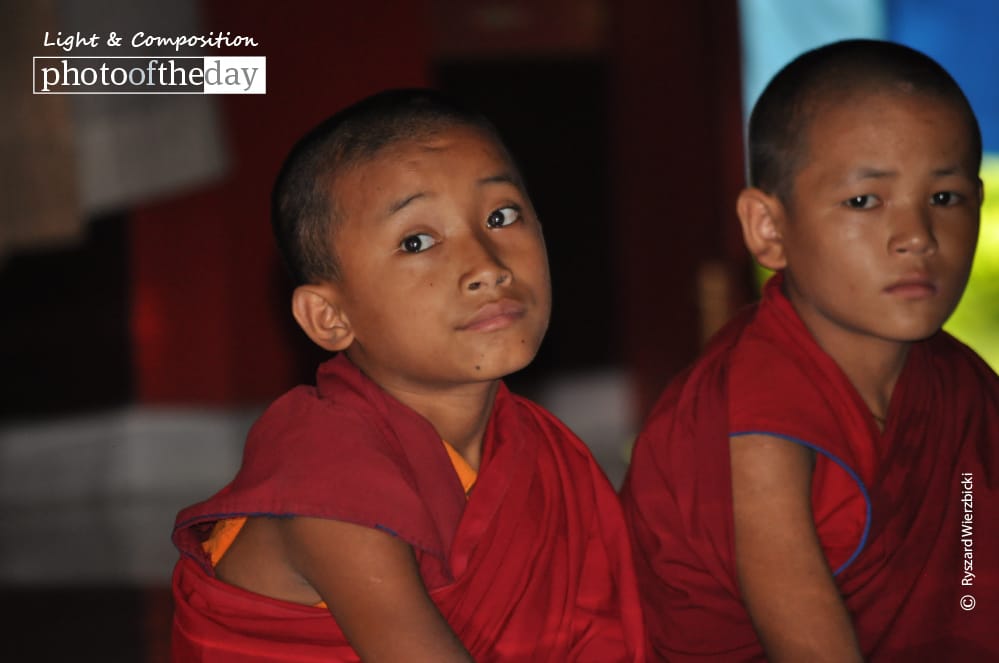
Exposure 1/750sec @ f/6.7 | ISO 200 | Focal Length 165mm
Ryszard Wierzbicki
Born in 1963, Ryszard Wierzbicki is a Polish-born photographer and educator currently based in Swindon, United Kingdom. After a diverse professional career in social sciences and marketing, he transitioned to a life of exploration, focusing his lens on the cultures and landscapes of South-East Asia. His work is deeply informed by his background in child care and his commitment to humanitarian efforts, such as volunteering with orphanages. Through his travel platforms, he shares a unique perspective that blends technical skill with a profound curiosity for the human experience.
Resonance Score Breakdown
Transparency Note: The resonance score (11.0/20) is calculated based on social engagement metrics collected before the award announcement.
Expert Photography Reviews · 5
The Weight of Stillness
There is a particular kind of waiting that belongs only to the young. It is a restlessness that has not yet learned to be impatient, a shifting of weight from one foot to the other while the world moves at a pace dictated by ancient rhythms.
Read the reflection →The Weight of Stillness
Time is a heavy cloak when you are young. It hangs from the shoulders, dragging its hem through the dust of long afternoons where the sun refuses to move and the shadows stretch like tired limbs.
Read the reflection →Reviews & Comments
Share your thoughts about this award-winning photograph. Your reviews contribute to the community engagement score.
Most critics obsess over the sharp focus on these boys’ faces, but I’m drawn to the restless, blurred limbs. It’s a kinetic tension that feels closer to Francis Bacon’s studies of movement than standard portraiture. Why resolve the background into such mundane clarity? I’d have preferred the environment to dissolve entirely, letting their fidgeting energy bleed into the frame. It’s a missed opportunity to abandon the Nikon’s clinical precision for something far more visceral.
1/750sec at f/6.7, 165mm. ISO 200. The shutter speed is overkill for static subjects, but it’s a smart hedge against the 200mm end of a consumer-grade lens. The aperture choice is the real win here; it isolates the subjects without turning the background into a muddy blur. It’s technically sound. I’ve spent years looking at soft, lazy portraits, so seeing this level of sharpness actually makes me exhale. It’s a clean, precise execution.
The architecture here isn’t just a backdrop; it’s a heavy, rhythmic datum that dictates the boys’ restlessness. The deep-set fenestration creates a harsh, directional light that carves out the mass of the stone, emphasizing the threshold between their internal play and the rigid, sacred void they inhabit. It’s a claustrophobic tension I’ve felt in too many monasteries. I’m struck by how the geometry traps them, making their boredom feel like a physical weight against the walls.
The saffron robes don’t merely clothe these boys; they ignite the frame with the searing, sun-drenched intensity of a Turner sunset, clashing beautifully against the dusty, muted ochres of the monastery floor. It’s a chromatic tension that makes my heart ache with the sheer, heavy weight of their stillness. One finds here the quiet, chalky stillness of a Morandi study, where the vibrant, sacred orange feels like a prayer caught in the throat of youth.
Before the eye identifies the saffron robes, a heavy, familiar stillness settles in the chest. It’s the ache of a long afternoon spent waiting for life to begin. I feel my own pulse slow, mirroring their slumped, restless postures. When I return to this a year later, the boredom feels less like a childhood phase and more like a permanent, quiet ache. It’s a beautiful, hollow ache that makes me want to reach out and touch their shoulders.