The House Sparrow by Masudur Rahman
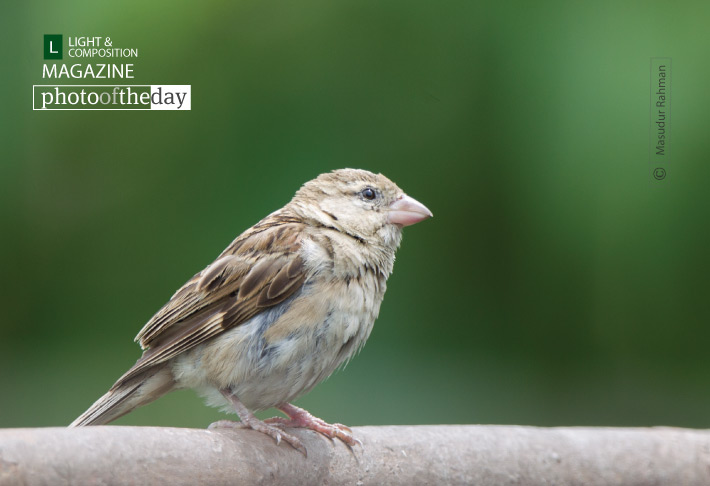
Captured from the vantage point of a home window, this portrait of a house sparrow elevates a common backyard visitor into a subject of striking intimacy. The photographer utilized a telephoto setup to isolate the bird against a soft, blurred background, highlighting the intricate textures of its plumage and its alert, plucky demeanor. By focusing on such a ubiquitous species, the image serves as a reminder of the beauty found in our immediate surroundings. Its technical precision and the clean, balanced composition demonstrate a keen eye for wildlife, turning an everyday encounter into a compelling, award-worthy study of avian life.
Masudur Rahman
Born in 1967, Masudur Rahman is a dedicated wildlife photographer based in Chittagong, Bangladesh. Since beginning his journey with film portraiture in 1998, he has transitioned his focus toward the natural world, particularly the study of birds. A member of the Chittagong Bird Club, he frequently contributes his photography and writing to local publications. Rahman views his craft as a vital medium for creative expression and social change, often traveling extensively across his home country to document its diverse avian life.
Resonance Score Breakdown
Transparency Note: The resonance score (13.1/20) is calculated based on social engagement metrics collected before the award announcement.
Expert Photography Reviews · 5
The Quiet Neighbor
We often look for the extraordinary in the distant or the rare, forgetting that the pulse of the world beats just as steadily in the corner of a garden or upon a familiar ledge.
Read the reflection →The Architecture of Small Things
We often mistake significance for scale, believing that only the vast—the mountain range, the storm-tossed ocean, the sprawling forest—holds the weight of truth. Yet, there is a quiet, rhythmic pulse in the things that share our fences and our windowsills.
Read the reflection →Reviews & Comments
Share your thoughts about this award-winning photograph. Your reviews contribute to the community engagement score.
The sparrow’s plumage, a dusty ochre reminiscent of Morandi’s muted still lifes, vibrates against a bokeh of soft, lichen-green whispers that I find utterly intoxicating. It’s not merely a bird; it’s a symphony of earthy, sun-drenched neutrals that breathe with the quiet humidity of a Chittagong afternoon. One feels the warmth radiating from those feathers, a delicate, tonal harmony that turns the mundane into a fleeting, golden-hued prayer I’d gladly hang in my own study.
At 420mm, the focal plane is razor-thin, yet Rahman has perfectly aligned the sparrow’s eye within that narrow depth of field. The diffraction limit at f/4.0 hasn’t softened the plumage; instead, the micro-contrast reveals structural iridescence I’ve rarely seen in such common subjects. It’s breathtaking. The bokeh, a function of that long telephoto compression, renders the background into a soft, painterly wash. I’m genuinely moved by how he’s captured such optical clarity in a fleeting, everyday moment.
1/320sec at f/4.0, 420mm. That 1.4x extender is a gamble, yet the 1D Mark IV handles it. The shutter speed is borderline for a sparrow’s twitchy movement, but the motion blur is absent. It’s sharp. I’ve spent hours chasing focus on smaller birds and usually fail; Rahman didn’t. The isolation is clinical, the plumage detail is precise. It’s a cold, calculated success. I actually find myself respecting the restraint here. It’s technically sound work.
Most wildlife photography is obsessed with the exotic, but I’ve seen enough tigers to last a lifetime. What separates this from the pack is the refusal to look away from the mundane. By isolating the sparrow’s frantic, alert eye against that soft, creamy bokeh, Rahman forces us to respect a bird we usually ignore. It’s a quiet, honest portrait. Honestly, it makes me want to put down my camera and just watch my own garden.
The sparrow’s placement within the frame creates a necessary fulcrum. It’s a study in geometric economy. The blurred background provides a neutral field, allowing the bird’s plumage to dictate the spatial tension. I’m genuinely struck by how the beak’s orientation anchors the entire composition. It doesn’t drift. The negative space isn’t wasted; it’s a deliberate silence. Rahman’s discipline holds the frame together. It’s a rare instance where the subject doesn’t collapse into mere sentiment.