The Hunter by Joaquín Alonso Arellano Ramírez
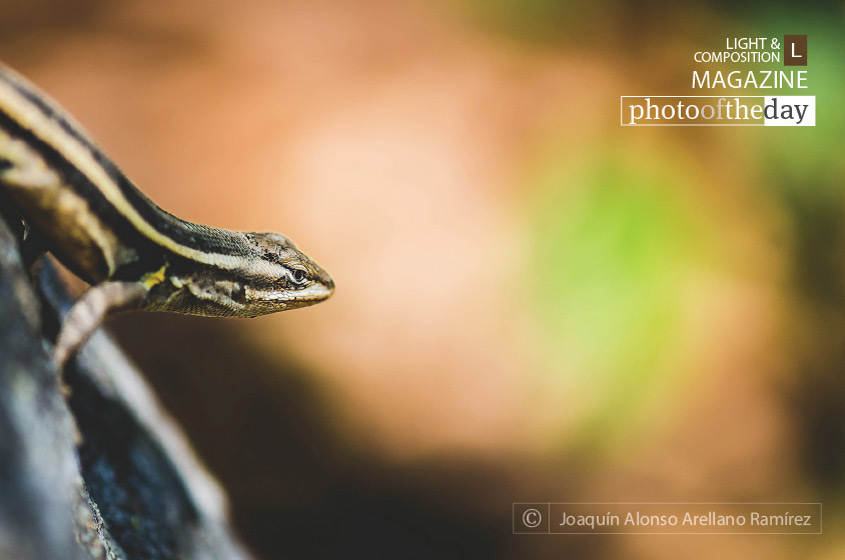
The Hunter captures a fleeting, intimate moment in the world of macro photography. Encountered by chance, the subject—a small lizard—is observed in its natural habitat during a hunting sequence. The photographer utilized a 105mm macro lens to achieve a shallow depth of field, isolating the creature against a soft, blurred background that emphasizes its intricate textures and predatory focus. This image is award-worthy for its technical precision and the patience required to document such a small-scale, high-speed interaction, transforming a serendipitous discovery into a compelling narrative of survival in the wild.
Joaquín Alonso Arellano Ramírez
Based in Monterrey, Mexico, Joaquín Alonso Arellano Ramírez balances a professional career as a software engineer with a deep-seated passion for nature and macro photography. Since acquiring his first DSLR in 2010, he has dedicated his free time to mastering the technical nuances of the craft and experimenting with diverse photographic techniques. His work is defined by a constant drive to learn and a keen eye for the natural world, which he documents with both precision and artistic curiosity.
Resonance Score Breakdown
Transparency Note: The resonance score (13.1/20) is calculated based on social engagement metrics collected before the award announcement.
Expert Photography Reviews · 8
The Weight of the Unseen
Can we ever truly know the intent of a life that does not speak our language? We often move through the world assuming that our own consciousness is the only one that carries the burden of purpose.
Read the reflection →The Stillness of the Hunt
There is a profound quiet that exists in the heart of a predator. It is not a silence of emptiness, but a state of absolute alignment.
Read the reflection →Reviews & Comments
Share your thoughts about this award-winning photograph. Your reviews contribute to the community engagement score.
Before the eye identifies the lizard, a sudden stillness grips the chest. It’s that predatory focus—the way the creature’s stillness mirrors our own held-breath anticipation. I’ve returned to this frame three times today, and each time, the blurred, verdant background feels more like a closing trap. It’s unsettling, really. That sharp, crystalline eye doesn’t just hunt insects; it tracks the viewer’s own pulse, dragging me into a quiet, cold survival I can’t quite shake.
The lizard’s skin, a mottled ochre reminiscent of Morandi’s dustiest jars, vibrates against the bokeh’s verdant, moss-choked depths, creating a chromatic tension that’s frankly intoxicating. It’s the precise, acidic chartreuse of a Turner storm-light caught in the creature’s unblinking eye that truly undoes me; one feels the heat of Monterrey radiating from those scales, a visceral, sun-drenched alchemy where the hunter’s stillness becomes a symphony of earth-tones, proving that nature’s palette is never merely decorative.
Macro work is usually a game of luck, but one suspects Ramírez didn’t just stumble upon this lizard. To catch that predatory focus at f/3.2 requires more than a quick shutter finger; it demands hours of stillness in the Monterrey heat. I’ve spent enough time prone in the dirt to know the ache of that wait. It’s a sharp, disciplined piece of work. He clearly didn’t mind the dust. I’m genuinely impressed by the restraint.
The lizard’s stillness is a lesson in devotion. He stood there, breath held, waiting for the creature to align with the sun’s low, raking warmth. It’s not just a macro shot; it’s a quiet communion with a tiny, predatory soul. I’ve spent hours waiting for such light, and looking at this, I feel a sudden, sharp ache for the desert’s silence. He didn’t capture a moment; he listened until the land finally allowed him to see.
We look into the eyes of this hunter and find a stillness that feels ancient. Joaquín didn’t just capture a lizard; he sat with a life force, listening to the rhythm of the hunt. The way the light catches those scales, it’s like reading a map of survival. I’ve spent my life studying human faces, yet this creature’s gaze holds a weight that truly humbles me. It’s a portrait that asks to be returned to.
The frame snaps shut, freezing a predator mid-breath. It’s a tight, kinetic sequence distilled into a single, breathless beat. That 105mm glass isolates the lizard’s intensity, turning a backyard encounter into a high-stakes thriller. I’ve spent hours in editing suites chasing this exact kind of tension, and honestly, it makes my pulse jump. The shallow depth of field keeps the focus lethal. It’s the shot the editor keeps, the one where the cut would have been a mistake.
The lizard’s lateral placement creates a rigid fulcrum, balancing the frame’s negative space against the creature’s predatory tension. It’s a disciplined geometry. The shallow depth of field isolates the texture, forcing the eye to confront the scale of the hunt. I’m genuinely unsettled by the sharpness of that eye. It doesn’t blink. The composition holds, though the background blur threatens to dissolve the structural integrity of the picture plane. It’s a precise, cold execution.
The lizard holds the frame. It doesn’t ask for attention. The background dissolves into a soft, green haze. I find myself holding my breath, afraid to disturb the stillness. It’s a rare, quiet tension. The creature is waiting. The blur behind it isn’t just space; it’s the absence of noise. Nothing here is accidental. The empty corner is not empty. It’s a pause. I’ve never seen a predator look so patient. It’s beautiful.