The Three Sisters by Minh Nghia Le
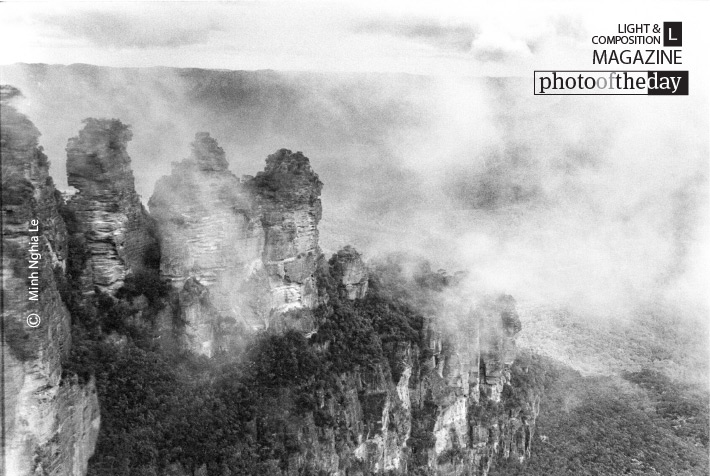
Captured in the Blue Mountains of New South Wales, this evocative image of the Three Sisters rock formation showcases the dramatic transformation of the landscape following a heavy downpour. As the rain subsided, a thick, ethereal mist rose from the Jamison Valley, cloaking the escarpment in a moody, atmospheric veil. The photographer’s decision to utilize black-and-white film emphasizes the stark textures of the ancient rock against the swirling clouds. This photograph is award-worthy for its masterful use of natural conditions, turning a challenging weather event into a sublime, timeless study of light, shadow, and the raw beauty of the Australian wilderness.
Minh Nghia Le
Based in Singapore, Minh Nghia Le is a dedicated photographer who balances a professional career with a profound, long-standing passion for the craft. While his primary focus lies in the nuanced fields of street photography and portraiture, his versatile portfolio extends into the realms of travel and wedding photography. Influenced by the philosophy that photography is a personal language used to articulate one's perspective on the world, he consistently seeks to capture the essence of his surroundings through a thoughtful and observant lens.
Resonance Score Breakdown
Transparency Note: The resonance score (4.4/20) is calculated based on social engagement metrics collected before the award announcement.
Expert Photography Reviews · 4
Stone Remains
The mountain does not hurry. It has seen the rain come and go for longer than the memory of any man. We look at the stone and we see permanence, but the stone is only waiting.
Read the reflection →When the World Goes Quiet
I remember standing on a ridge in the Blue Mountains just as a storm broke. The air was heavy, smelling of wet eucalyptus and cold stone, and for a few minutes, the entire valley simply vanished.
Read the reflection →Reviews & Comments
Share your thoughts about this award-winning photograph. Your reviews contribute to the community engagement score.
Most tourists flee when the heavens open, but Le clearly stayed until his boots were ruined and his patience rewarded. That mist doesn’t rise for the casual snapper; it demands a long, shivering vigil. I’ve spent enough hours in similar damp misery to recognize the commitment here. The Leica choice is sharp, and the textures are honest. It’s a rare pleasure to see someone actually earn their light instead of merely stumbling upon it.
1/500sec at f/11 on a 50mm lens. It’s a rigid, clinical choice for a landscape, but it works. Stopping down to f/11 forces the Nokton to resolve the sandstone textures against that dense mist. I’ve spent years staring at these formations, and honestly, the sharpness here is unsettling. It’s technically sound, though the ISO 400 grain feels a bit heavy for such a static subject. Still, the math holds up. It’s a precise, cold execution.
The rain had finally stopped, leaving the valley floor to exhale its heavy, white breath. He stood there in the damp silence, waiting for the mist to reveal the stone. It’s a quiet, ancient conversation. I feel a chill just looking at those jagged, monochrome edges emerging from the fog. He didn’t rush the shutter; he let the mountain dictate the moment. It’s a rare, patient grace that turns a storm into a prayer.
Stopping down to f/11 on the Nokton 50mm pushes the diffraction limit, yet here it’s a deliberate choice. The lens resolves the sandstone’s micro-textures against the Jamison Valley’s vaporous diffusion with startling clarity. I’m genuinely moved by how the glass renders those swirling mists; it’s a tactile, almost liquid transition from sharp rock to soft air. It doesn’t just capture a landscape; it maps the precise interaction between ancient geology and the physics of light.