Without Judgment by Faisal Khan
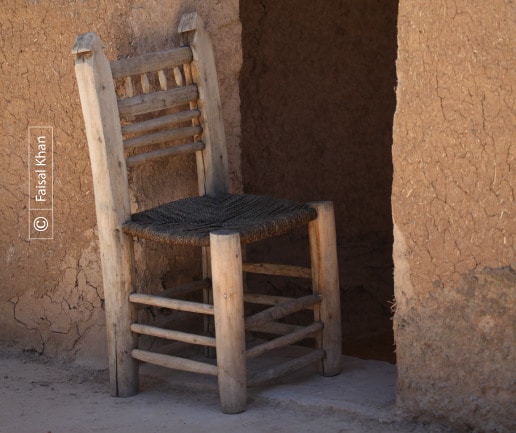
Captured at the entrance of an old house in Marrakesh, this photograph centers on a solitary chair, prompting a profound meditation on the nature of authority versus humility. The photographer utilized a 104mm focal length to isolate the subject, creating a crisp, deliberate composition that invites the viewer to question the history and intent behind the object. By focusing on this singular, weathered piece, the image transcends its physical setting to become a philosophical inquiry. Its award-worthy quality lies in this ability to transform a mundane architectural detail into a compelling narrative of human experience and spiritual reflection.
Faisal Khan
Raised in Saudi Arabia and currently based in Casablanca, Morocco, Faisal Khan is a chemical engineer turned photographer whose work is deeply rooted in travel, spirituality, and self-discovery. His photographic journey, which began as a pursuit of connection with nature and the divine, serves as a meditative practice that captures the majesty of creation. Through his lens, Khan seeks to inspire others toward positive personal growth, viewing each image as a contemplative reflection of his global experiences and his ongoing quest to find beauty in the world's diverse cultures.
Resonance Score Breakdown
Transparency Note: The resonance score (13.3/20) is calculated based on social engagement metrics collected before the award announcement.
Expert Photography Reviews · 7
The Weight of Empty Wood
We leave things behind. A coat on a hook, a cup on a table, a chair facing a wall. These objects do not mourn us.
Read the reflection →The Architecture of Waiting
We often mistake stillness for an absence of life, as if a room left empty is a story that has reached its final period.
Read the reflection →Reviews & Comments
Share your thoughts about this award-winning photograph. Your reviews contribute to the community engagement score.
Most entries I see in this category rely on heavy-handed symbolism, but this chair holds its own. The 104mm compression flattens the Marrakesh light, forcing us to confront the wood’s decay rather than the setting. It’s a quiet, stubborn piece of work. I’ve stared at it for ten minutes, and honestly, it makes me feel small. That’s why it endures. It doesn’t ask for your attention; it simply waits for you to realize it’s already there.
A chair. Weathered wood against stone. It’s a quiet invitation. I’ve spent minutes staring at the shadow beneath the seat. It doesn’t demand attention. It simply exists. The frame breathes because the photographer knew when to stop. Nothing here is accidental. The empty corner is not empty. It’s a pause. I feel a sudden, sharp ache for the person who isn’t sitting there. The silence is heavy. It’s perfect.
At f/4.5, the 104mm focal length renders the chair’s weathered texture with surgical precision. The focal plane is razor-thin, isolating the wood grain from the Marrakesh heat haze. I’m genuinely moved by how the lens resolves the micro-contrast in those fibers; it’s a tactile revelation. The diffraction limit hasn’t softened a single splinter, and the bokeh, as a function of that aperture, creates a depth that feels almost physical. It’s an optical triumph of quiet, structural honesty.
A solitary chair in Marrakesh. It’s a quiet study, though one wonders if the photographer merely stumbled upon it or sat in the dust until the shadows aligned. The composition is tidy, perhaps too tidy. I’ve spent enough hours shivering in doorways to know that light like this rarely arrives on a whim. It’s a decent effort, but I’d have liked to see more grit. It’s clean, but has it been truly earned?
The chair’s placement against the textured masonry creates a rigid, vertical axis that anchors the frame. It’s a study in spatial tension. The 104mm compression flattens the depth, forcing the weathered wood into a singular, uncompromising plane. I’m genuinely unsettled by how the negative space around the legs refuses to resolve. The composition holds because the geometry is absolute. It doesn’t need a narrative. The structure is the only truth here. It’s remarkably precise.
The ochre of this Marrakesh wall, a shade reminiscent of Morandi’s dust-laden plaster, vibrates against the chair’s deep, bruised umber, creating a tension that’s almost visceral. It’s a chromatic dialogue of exhaustion and endurance, where the light doesn’t merely illuminate but stains the wood with the heavy, golden heat of a dying afternoon. I’m utterly breathless before such quietude; it’s as if the very air has thickened, trapping the soul of the desert within these pigments.
The light here doesn’t demand attention; it simply rests upon the wood. I’ve spent enough afternoons in Marrakesh to know that specific, dusty warmth. Faisal waited until the shadows pulled back, leaving the chair in a quiet, humble state of grace. It’s a lonely sight, yet it feels entirely at peace. Looking at it, I feel a sudden, sharp ache for the silence of that doorway. He listened well. The land was finally ready.