Identifying Lizard by Rahat Azim Chowdhury
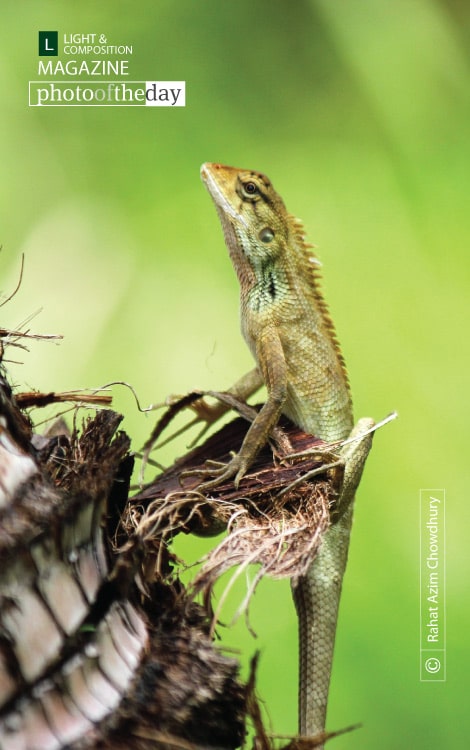
While traveling through Kaptai, Rangamati, the photographer encountered an Oriental Garden Lizard resting beneath a coconut tree. Capturing this elusive subject required immense patience and a stealthy approach, as the lizard possesses a keen sense of its surroundings. By crawling into position and utilizing natural cover, the photographer successfully documented the creature’s intricate physical details. This image is award-worthy for its technical precision and the photographer's commitment to wildlife observation, effectively dispelling local myths about the species while highlighting the vibrant, natural biodiversity found within the landscapes of Bangladesh.
Rahat Azim Chowdhury
Born in 1984 and based in Dhaka, Bangladesh, Rahat Azim Chowdhury is a computer engineer who transitioned into a dedicated photographer. Inspired by his peers and a commitment to self-directed learning, he has honed his craft through intensive study and formal training at the PRISM Photography Institute. His diverse portfolio spans nature, wildlife, street, and architectural photography, all driven by a desire to document global social patterns and human lifestyles. Chowdhury strives to develop a unique visual signature, prioritizing artistic exploration and authentic storytelling over commercial trends.
Resonance Score Breakdown
Transparency Note: The resonance score (12.8/20) is calculated based on social engagement metrics collected before the award announcement.
Expert Photography Reviews · 8
The Texture of Stillness
There is a particular grit to the earth when you press your palms into it, a cool, damp resistance that speaks of things buried deep.
Read the reflection →The Architecture of Stillness
How much of the world do we miss simply because we refuse to be as quiet as the earth beneath us? We move through our days with a heavy, rhythmic urgency, convinced that our presence is the most significant event in any room or forest.
Read the reflection →Reviews & Comments
Share your thoughts about this award-winning photograph. Your reviews contribute to the community engagement score.
At 200mm, the EF-S 55-250mm struggles with the diffraction limit, yet Chowdhury’s focal plane is razor-sharp across the lizard’s granular scales. I’m genuinely moved by how the f/5.6 aperture renders the bokeh; it’s a soft, creamy transition that isolates the subject from the chaotic foliage. The chromatic aberration is remarkably well-controlled for this glass. It’s a rare, precise capture where the optics don’t just resolve the creature—they reveal its alien, prehistoric texture to us.
Most wildlife shots are just trophies, but this lizard’s gaze feels like a confrontation. I’ve seen thousands of macro captures, yet few hold this level of stillness. The way the texture of the scales bleeds into the bark creates a camouflage that’s almost disorienting. It’s not just technical precision; it’s the patience that makes me hold my breath. In thirty years, this won’t just be a record of a species; it’ll be a reminder of quiet observation.
Before the eye identifies the lizard, something in the chest tightens. It’s that primal, held-breath moment of encountering the wild. The creature’s stillness demands a physiological surrender; I find my own pulse slowing to match its rigid, scaled posture. A year later, I still feel the humidity of that Kaptai shade. It’s not just a study of biology; it’s a quiet, unsettling reminder that we are being watched by eyes far older than our own.
The lizard’s skin, a mottled tapestry of lichen-green and the dusty, sun-bleached ochre of a Morandi still life, vibrates against the coconut bark’s deep, umber shadows. It’s a chromatic dialogue of survival, where the creature’s subtle, earthy pigments dissolve into the forest floor. I’m breathless at how the light catches that singular, iridescent throat-patch, a flash of molten copper that feels like a secret whispered in the humid heat of Rangamati. It’s simply exquisite.
The lizard waits, still as the earth itself. Rahat must have held his breath, pressing into the damp soil of Kaptai until his own heartbeat slowed to match the creature’s rhythm. It’s a quiet communion. I’ve spent hours in such stillness, and I feel a sudden, sharp ache of recognition in my chest. The light here isn’t just illumination; it’s a soft, patient conversation between the lens and the wild, hidden life of the forest.
The lizard’s diagonal alignment creates a necessary fulcrum against the verticality of the coconut bark. It’s a rigid geometry that anchors the frame. The negative space, while cluttered, doesn’t collapse under the weight of the subject’s intricate scales. I’m genuinely struck by how the texture of the bark dictates the lizard’s stillness. It’s a disciplined study of camouflage. The composition holds, even if the background noise threatens to break the frame’s structural integrity.
1/800sec at f/5.6, 200mm, ISO 400. The shutter speed is adequate for the lizard’s stillness, but f/5.6 on a 55-250mm lens at 200mm is a compromise. You’ve lost the background separation I’d demand for a clean macro-style study. It’s technically functional, yet the depth of field feels muddy. I’ve spent hours chasing reptiles in the heat; I respect the patience, but the optics don’t quite justify the effort here. It’s a decent record, nothing more.
The lizard clings to the bark. It’s a study in stillness. I’ve spent minutes watching the texture of the wood, the way the creature’s scales mirror the grain. It doesn’t demand attention. It simply exists. The surrounding space isn’t just background; it’s the breath the subject needs to survive. I feel a sudden, sharp calm looking at it. Nothing here is accidental. The empty corner is not empty. It’s a quiet, perfect pause.