Sahara Palms by Abdellah Azizi
Captured during the golden hour in the Moroccan Sahara, this evocative image features two young men silhouetted against the fading light, moments before they joined a local music concert. The photographer expertly utilized a high shutter speed to freeze the atmosphere, balancing the vibrant warmth of the desert sunset with the candid stillness of the subjects. The composition is masterfully framed, drawing the viewer into the vast, serene landscape of N'kob. This photograph is award-worthy for its ability to capture a fleeting, authentic cultural moment, blending the raw beauty of the North African terrain with a poignant sense of human connection and anticipation.
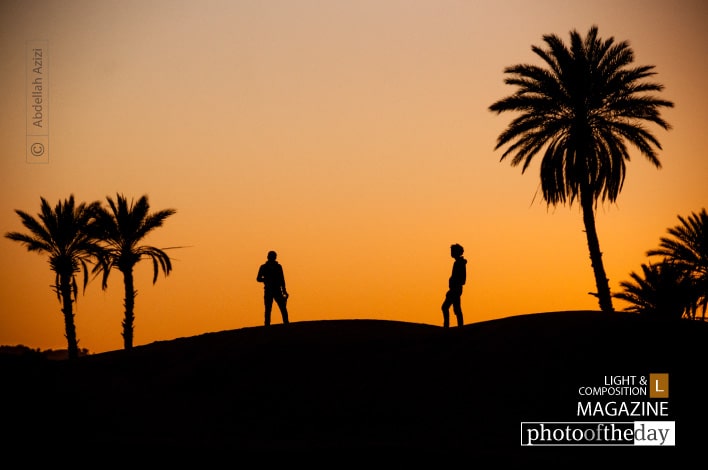
Exposure 1/3200sec @ f/5.6 | ISO 500 | Focal Length 150mm
Abdellah Azizi
Born in Ouarzazate in 1987, Abdellah Azizi is a dedicated Moroccan photographer known for his evocative documentation of South Moroccan landscapes, local folklore, and the vibrant rhythms of African life. With a formal background in film lighting, camera work, and audio-visual post-production, he transitioned into professional photography after honing his skills as a videographer and lighting technician. Azizi finds profound creative freedom in the medium, using his technical expertise to capture the authentic spirit of his homeland and its people.
Resonance Score Breakdown
Transparency Note: The resonance score (12.9/20) is calculated based on social engagement metrics collected before the award announcement.
Expert Photography Reviews · 8
The Weight of the Horizon
In the high deserts of the world, silence is not merely the absence of sound; it is a physical presence, a heavy curtain that falls between the earth and the sky.
Read the reflection →The Weight of the Horizon
There is a quiet gravity to the end of the day, a moment when the earth seems to hold its breath before the stars emerge.
Read the reflection →Reviews & Comments
Share your thoughts about this award-winning photograph. Your reviews contribute to the community engagement score.
The horizon line bisects the frame with clinical precision, anchoring the two silhouettes against the desert’s expansive void. It’s a rigid geometry that forces the eye toward the negative space between the figures. The tension here is palpable; the subjects don’t merely exist, they define the frame’s weight. I’ve grown weary of sentimental sunsets, yet this structural discipline demands respect. It’s a rare instance where the composition doesn’t collapse under the burden of its own light.
Shadows here aren’t merely absent light; they’re the heavy, ink-stained silence of the Sahara. By crushing these figures into silhouettes, Azizi forces us to confront the void. It’s a brutal, necessary erasure. I’ve stared at these two men for an hour, and I’m unsettled by how they refuse to reveal their faces. They don’t invite us in. They exist in the dark, resisting the golden hour’s cheap sentimentality. It’s a profound, lonely act of defiance.
At 150mm, the Nikon’s glass struggles with the high-contrast transition between the Saharan glare and the subjects’ silhouettes. While the f/5.6 aperture keeps the focal plane tight, I’m struck by the subtle longitudinal chromatic aberration fringing the palms. It’s a technical imperfection, yet it renders the heat haze with haunting, visceral accuracy. I’ve spent years analyzing optics, but this raw, shimmering diffraction of light across the horizon genuinely makes my pulse quicken. It’s simply beautiful.
The desert heat doesn’t reach me here. It’s the silence that lingers. Two figures against the horizon. They aren’t waiting for music. They are waiting for the light to vanish. I’ve spent minutes staring at the sand beneath their feet. It’s vast. It’s heavy. Nothing here is accidental. The empty corner is not empty. It’s a breath held in the throat of the Sahara. I feel a sudden, sharp ache for that stillness. It’s perfect.
Most desert shots rely on the cliché of endless dunes, but this works because of the tension between those two silhouettes and the encroaching shadow. I’ve seen thousands of sunset frames, yet the way the light catches the palms’ edges here feels rare. It’s not just a concert prep; it’s a quiet, suspended breath. I’ll admit, it made me miss the silence of the Sahara. Thirty years from now, this stillness will still feel earned.
The desert doesn’t just hold heat; it holds breath. Azizi waited for the sun to surrender, catching these silhouettes just as the light turned to liquid gold. I’ve felt that same stillness in N’kob, where the air grows heavy with the coming night. It’s a quiet, holy anticipation. Seeing these two figures against the vast, cooling dunes, I feel a sudden, sharp ache for the silence of that place. He listened, and the land spoke.
The ochre of the N’kob dunes doesn’t merely sit behind these figures; it bleeds into the atmosphere like a Turner sunset, thick with the heat of a dying day. I’m breathless at how the burnt-sienna shadows cling to their silhouettes, creating a chromatic tension that feels almost tactile. It’s a Morandi-esque study in restraint, where the light’s amber viscosity holds the stillness of the desert, making one ache for the music they’re about to ignite.
Before the eye identifies the silhouettes, a sudden stillness settles in the chest. It’s the weight of that Moroccan heat, caught in the amber light. I feel my own pulse slow, mirroring their quiet anticipation. When I return to this, I’m not looking at palms or desert; I’m remembering the ache of waiting for something beautiful to begin. It’s a rare, suspended breath that stays with me long after I’ve turned away.